Travel vaccination
Hepatitis B Vaccine for Work in Epsom
Hepatitis B spreads through blood, so the risk sits with the jobs where blood and sharps are part of the day: care and healthcare work, dentistry, tattooing and piercing, laboratories and the emergency services.
- Registered Yellow Fever Vaccination Centre
- GPhC premises 9011598
Recommendations depend on your itinerary, health history and current guidance.

NaTHNaC Registered Yellow Fever Vaccination Centre
A Yellow Fever Vaccination Centre on the NaTHNaC register, and the same travel clinic that gives your other vaccinations.
GPhC registered premises
9011598
Private and NHS pharmacy services from one registered pharmacy in Ewell, Epsom.
In short
If hepatitis B vaccination is a requirement of your job, your employer is responsible for arranging it and for the cost. How that reaches you varies: some employers have occupational health, some ask you to claim the cost back, some have nothing. Miles Pharmacy in Epsom gives the course, invoiced to the business or paid with a receipt.
- Who pays
- Your employer if it is a requirement of the job, HSE says the cost cannot be passed to you
- If you pay today
- Receipt per dose HSE says an employer must reimburse what a member of staff was charged
- The course
- Three or four doses depending on how soon protection is needed
- Price
- £55 a dose
Where you stand
The short version of what HSE and the BMA say, with the links so you can read it yourself. It reads the same whether you are arranging this for a team or for yourself.

- It starts with a risk assessment
- Under COSHH the employer assesses the risk of exposure to bloodborne viruses and puts measures in place. Where that assessment finds a real exposure risk and a vaccine exists, they check whether a person is already immunised and offer it to those who are not.
- The cost is the employer's, not the worker's
- HSE is unambiguous: employers must pay for protective measures such as immunisation. Section 9 of the Health and Safety at Work Act stops an employer charging staff for anything done to meet a health and safety requirement, including through a wage deduction.
- "Ask your GP" is not a way out
- An employer can ask staff to try their own GP, but has to make alternative arrangements if that cannot be done, and reimburse anything the member of staff was charged.
- Which is why most GPs decline
- Occupational health is not part of the NHS GP contract. A practice can take it on privately, but it can only accept a fee from an employer, never from its own registered patients.
- It is a role question, not a job title
- HSE says any requirement is determined as part of the risk assessment, so a carer doing personal care and a receptionist in the same business can get different answers.
Four ways this reaches people, and what to do in each
The duty is the employer's in all four. What changes is who you should be talking to first, and we would rather you used a route you have already paid for than buy it from us.
Your employer has occupational health. Larger employers, NHS trusts especially, run or buy in an occupational health service, and hepatitis B vaccination is part of what it covers. If that is you, go there first. It is already funded, they hold the records your employer needs, and you should not be paying us for it. Come to us if they cannot fit you in before a start date.
Your employer will pay, but is not set up to arrange it. Common in care homes, dental and domiciliary agencies, studios and small practices. The duty and the cost are still theirs. We invoice the business directly, which is the way round the law requires, so nothing is taken from your staff.
You are paying now and claiming it back. A lot of nurses, agency and bank staff and students do exactly this, because a start date will not wait for a purchase order. You pay at the counter and we give you a receipt for each dose. HSE says an employer must reimburse what you were charged to meet a health and safety requirement, so keep them. Ask your employer what they need on the receipt before your first dose.
You are self-employed. A self-employed tattoo artist, piercer, locum or contractor is their own employer for this purpose, so the assessment and the cost are both yours. Keep the receipts for your own records; how you treat the cost in your accounts is a question for your accountant, not for us.
The roles the guidance names
From the Green Book. Use it as a starting point for your assessment rather than a list to vaccinate wholesale.
-
Healthcare workers, students and trainees
Anyone with direct contact with patients' blood, blood-stained fluids or tissues, or at risk of sharps injuries or bites. That includes nursing, medical, dental and allied health students before placements, agency and bank staff, and overseas-trained staff joining UK employers. Many employers and universities pay for it, but a lot of people end up arranging it themselves.
-
Social care staff who use needles
Adult social care staff who regularly use needles or lancets on clients, following an occupational health risk assessment.
-
Tattoo artists, piercers, morticians and embalmers
Any job that routinely involves needles puncturing skin. Usually self-funded, and often asked for by licensing or insurers.
-
Laboratory staff
Anyone handling material that may contain the virus. Staff working with hepatitis A, and in some learning disability settings, can be offered hepatitis A vaccine too.
-
Learning disability settings
Staff in residential, day-care and school settings where biting or scratching is likely, based on a local risk assessment.
-
Prison, police, fire and rescue
Prison staff in regular contact with prisoners, and emergency services staff who frequently handle discarded needles, following a risk assessment.
-
Combat sports
Boxers, MMA fighters and wrestlers with regular exposure to blood during bouts.
-
Work it out for your trip
Who should be arranging this, and who pays?
Work it out
Who should be arranging this, and who pays?
It answers the money and the paperwork, not whether your role needs the vaccine. That part gets confirmed at the appointment against your own records.
This works out an answer in your browser. With JavaScript off, the sections below say the same thing in full.
Call us on 020 8393 1000Your answer
- Ways this gets arranged
- 6
- Of those, routes where somebody else pays
- 4
- Rules last checked
- 22 September 2026
A guide to who arranges and who pays, drawn from HSE and BMA guidance. It is not legal advice and not a risk assessment for your business, and it does not decide whether a role needs the vaccine. We confirm that with each person at their appointment.
What we do, and what we do not

- The course, one person at a time
- The full hepatitis B course, three or four doses depending on how soon protection is needed, at the schedule that fits the person and the date they have to be covered by. Everyone is assessed on their own records, because the right schedule is not the same for everyone on a list.
- Billed whichever way suits
- Invoiced to the business, or paid at the counter with a receipt for each dose if you are claiming it back. It makes no difference to the appointment.
- We say when you should not be paying us
- Some people are already immune. Some qualify on the NHS for reasons that have nothing to do with work. Some have an occupational health service that already covers this. We say so rather than taking the money.
- Not a substitute for occupational health
- We give vaccine and keep our own record of what we gave. A risk assessment, health surveillance and staff records stay with the employer.
What it costs
£55 a dose
| Schedule | What that covers | Price |
|---|---|---|
| Standard | 3 doses, £55 each | £165 |
| Accelerated | 4 doses, £55 each | £220 |
| Very rapid | 4 doses, £55 each | £220 |
One price, paid at the appointment. We confirm what you need before you pay for anything.
Why the course alone is not the end of it
For work purposes what gets asked for is evidence that the course worked, not evidence that it happened.
- Who
- Healthcare and laboratory workers, people with kidney failure, and some people with weakened immune systems. It isn't routinely needed for travel.
- When
- One to two months after the final dose of the course. Testing earlier doesn't tell you anything useful, because you may still respond to the last dose.
- Reading the result
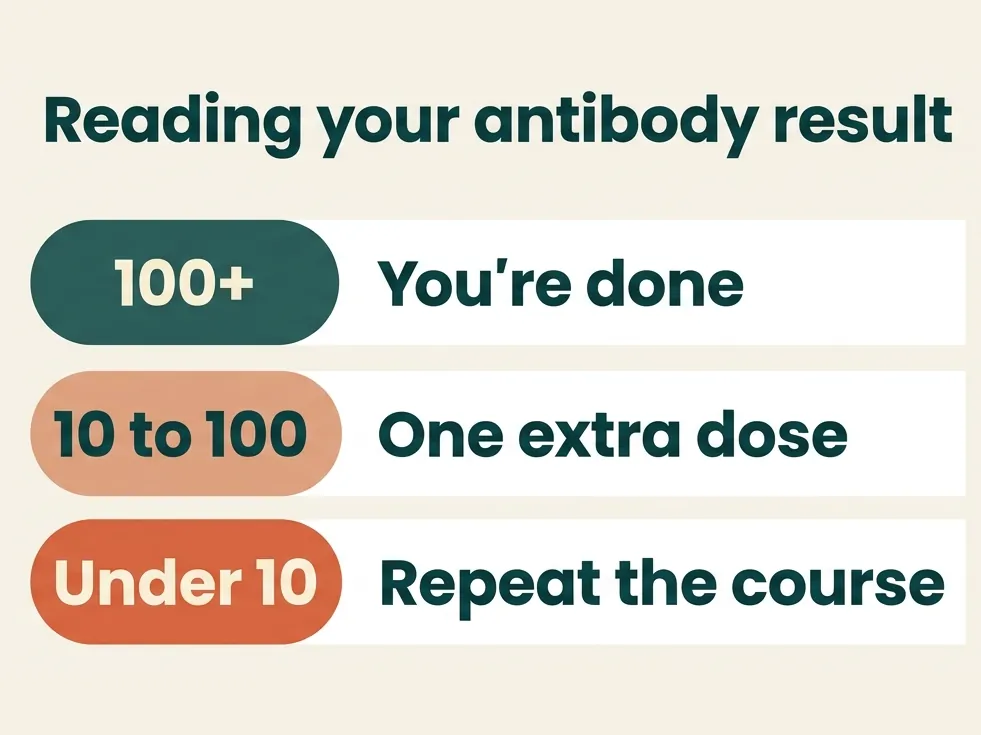
- At 100 or more, you're done: no further doses or tests. Between 10 and 100, one extra dose and no more testing. Under 10, the next step is checking for past infection and repeating the full course, then testing again.
- If you missed the test
- Healthcare workers who never had their antibodies checked after the course should be tested now and managed on the result.
- Why it matters at work
- Under COSHH regulations you have a right to know whether you're protected, and it decides what happens after a needlestick injury.
Work it out
Plan it around a start date
Enter the day they need to be covered by and it dates the schedules against it.
This works out an answer in your browser. With JavaScript off, the sections below say the same thing in full.
Call us on 020 8393 1000Your answer
- I know which schedule
- Every dose date, the date protection is expected, and the antibody test window if relevant
- I need protection by a date
- Which schedules finish in time, with the fastest shown first and the 12-month dose flagged
- I've had some doses
- What's left and when, without restarting
A guide to the dates. We confirm the right schedule for each person at their appointment.
If it has already happened
If someone is exposed at work
This isn't a booking. It's same-day advice.
Call us on 020 8393 1000What counts. A needlestick or sharps injury, a bite that broke the skin, blood splashed into your eyes or mouth, or unprotected sex with someone who has hepatitis B.
Right now. Wash the area with soap and warm water. Don't scrub or suck the wound.
Then. Get advice today from A&E, NHS 111 or your occupational health service. Vaccination works best within 24 hours and can still help up to a week afterwards, sometimes with immunoglobulin as well.
Arranging it, whoever is paying
-
Call us first
Tell us roughly how many people and the dates you are working to, and we will check we can get the stock. Hepatitis B courses run over months, so the first date matters less than the plan.
-
Send us what you have
Any existing immunisation records for the people involved. A course is resumed rather than started again, however long the gap, so old records save you money.
-
Each person is seen individually
We check their records and their reason for vaccination before the first dose. If somebody should not be on your invoice, that is when we say so.
Before you book
Questions about the hepatitis B vaccine
Answered by the pharmacist who signs this page off.
-
If your risk assessment says a role needs it, yes. HSE says employers must pay for protective measures such as immunisation, and Section 9 of the Health and Safety at Work Act stops you charging staff for anything done to meet a health and safety requirement, including by wage deduction.
-
You can ask, but it is not a way out. HSE says you have to make alternative arrangements if it cannot be done, and reimburse anything your employee was charged. Most practices decline: occupational health is not part of the NHS GP contract, and a practice offering it privately can only bill an employer, never its own registered patients.
-
It follows your risk assessment rather than job titles. The Green Book names healthcare workers with direct contact with blood, blood-stained fluids or tissues, staff at risk of sharps injuries or of being bitten, and staff in residential settings for people with learning difficulties. HSE is clear that a carer doing personal care and a receptionist in the same business can get different answers.
-
Usually three or four, depending on the schedule. Children aged 11 to 15 can have two adult-strength doses six months apart.
-
On the very rapid schedule, adults are protected about three weeks after starting. Other schedules take one to two months. You aren't fully protected after one or two doses.
-
£55 per dose. That's £165 for the three-dose standard course, or £220 for the four-dose accelerated and very rapid schedules.
-
Yes. We bill the business rather than taking payment from your staff, which is the way round the law requires.
-
No. Pick up where you left off, however long ago it was. The course is resumed, never restarted.
-
Healthy people who've finished a course and responded aren't usually offered a booster, for travel or for work. Boosters are only considered for kidney failure, after a significant exposure, or for healthcare workers who didn't respond. Bring your records and we'll check at your appointment.
-
Don't wait for an appointment. Wash the area and get advice today from A&E, NHS 111 or your occupational health service. Vaccination works best within 24 hours.
-
No. It summarises HSE, BMA and Green Book guidance so you know where you stand. If you are writing a policy around it, have the wording checked by someone qualified.

Guides and advice
Guides on hepatitis B
-
 Hepatitis B
 vaccine for nursing, medical and dental students
-
 Hepatitis B
Do you need a hepatitis B booster? How long the vaccine lasts
-
 Hepatitis B
 vaccine for tattoo artists, piercers and aesthetics practitioners
Guides are a starting point, not a diagnosis. What is right for you depends on your health history, your medicines and what a pharmacist finds on the day.
Find the pharmacy
Where to come, and when
Miles Pharmacy is in Epsom, Surrey. Patients come to us from across Surrey, including Ewell, Ashtead, Leatherhead and Banstead, and from Sutton, Cheam, Surbiton and Kingston in south-west London.

Ewell, Epsom, Surrey KT19 9UR
How to get here Parking, trains, buses and step-free access
-
The door is on Chessington Road, with step-free access
-
The station car park, on Station Approach off Chessington Road
- Address Elizabeth Court, Station Approach, KT17 1DR
-
Step-free to all platforms, by a footbridge with lifts
- Step-free to every platform (National Rail step-free category A)
- Lifts two, on the footbridge
Checked against nationalrail.co.uk
-
Outside the pharmacy, with a stop on each side of Chessington Road
-
Cycle parking at the station
Take this with you
Point your phone's camera at the code and this page opens there, with the directions one tap away.
Sources
- UKHSA Green Book chapter 18: hepatitis B, dated . Checked .
- NaTHNaC hepatitis B factsheet. Checked .
- HSE: bloodborne viruses, immunisation and who pays. Checked .
- BMA: focus on hepatitis B immunisations and occupational health. Checked .
Travel health
Book before you pack.
Choose a service and a date that suits you. One of us confirms it with you directly.
- Private and NHS
- GPhC premises 9011598
- Open until 6:30pm
Prefer to talk? 020 8393 1000