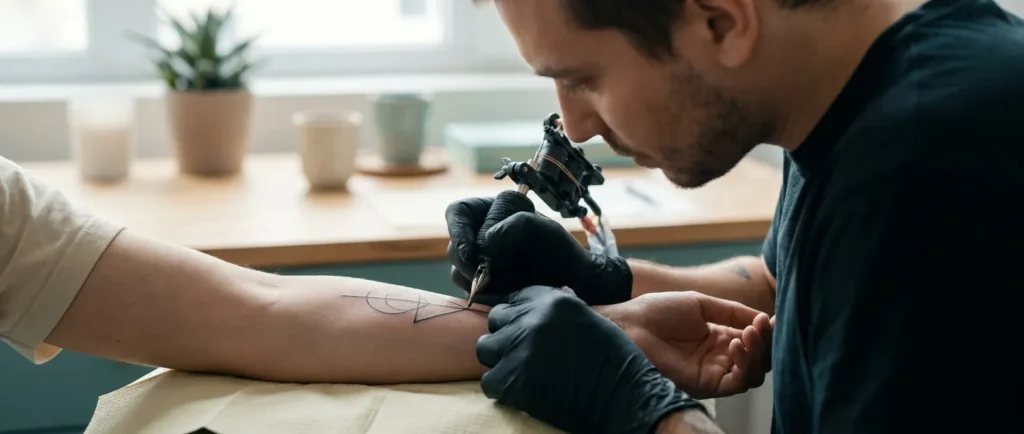
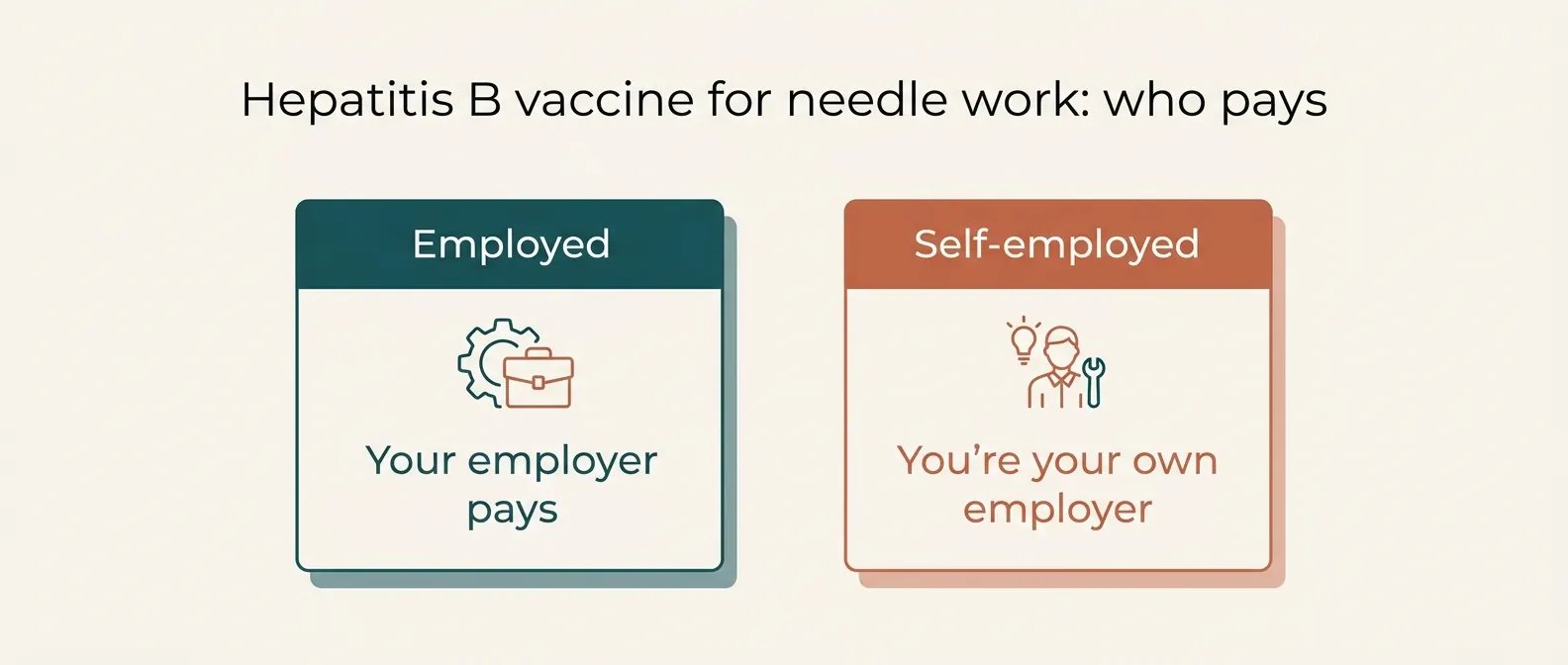
UK guidance says hepatitis B vaccination should be offered to tattoo artists and anyone whose job routinely involves using needles to puncture or pierce the skin, because the work carries a risk of exposure to blood. National guidance for tattooing and piercing says practitioners’ precautions should include immunisation against hepatitis B. If you’re employed, your employer pays; if you’re self-employed, you’re your own employer for this. You can book your hepatitis B vaccination for work in Epsom with us.
Why it matters in needle work
Hepatitis B spreads through blood. In tattooing and piercing, the main concern is the risk of passing on viruses carried in blood, including hepatitis B, between client and practitioner. Safe practice and sterile equipment come first, and the vaccine adds protection for you.
Who it covers
UK guidance names tattoo artists, morticians and embalmers, and covers any job that routinely involves using needles to puncture or pierce the skin. Kingston council lists microblading and micro-pigmentation alongside tattooing and body piercing as high-risk treatments.
Licensing around Epsom
| Council | What it licenses or registers |
|---|---|
| Epsom and Ewell Borough Council | A licence for acupuncture, tattooing, cosmetic piercing, skin colouring and electrolysis, for both the practitioner and the premises, under the Local Government (Miscellaneous Provisions) Act 1982 |
| Reigate and Banstead Borough Council | Registration for each practitioner and premises, to protect public health from viruses carried in blood, including hepatitis B |
| Mole Valley District Council | Registration for acupuncture, tattooing, ear piercing and electrolysis, with byelaws on hygiene |
| Royal Borough of Kingston upon Thames | A special treatment licence under the London Local Authorities Act 1991, with tattooing, microblading and body piercing listed as high-risk |
| London Borough of Sutton | A special treatment licence under the London Local Authorities Act 1991 |
None of the council pages we checked lists the vaccine as a condition of the licence. National guidance and your health and safety duties are where it comes from.
Who pays
Employed artists and apprentices
HSE says that under the Health and Safety at Work Act, employers must pay for protective measures such as immunisation, once their risk assessment shows a risk. If you pay us yourself, keep the receipt for each dose to claim it back. We can also invoice the studio directly.
Self-employed
If you work for yourself, you’re your own employer for this, so the risk assessment and the cost are yours. Keep your receipts for your records.
Fitting it around a licence or start date
| Time until you start | Schedule that fits | Price at Miles |
|---|---|---|
| 3 weeks or more | Very rapid: days 0, 7 and 21, then 12 months (adults) | £220 |
| About 2 months or more | Accelerated: 0, 1 and 2 months, then 12 months | £220 |
| 6 months or more | Standard: 0, 1 and 6 months | £165 |
Our guide to hepatitis B vaccine schedules explains each one, including why the 12-month dose matters.
Aesthetics: the licensing scheme on the way
The Health and Care Act 2022 lets the government set up a licensing scheme for non-surgical cosmetic procedures in England. In its August 2025 response to the consultation, the government said premises will need to meet standards of hygiene and infection control, and that the highest-risk procedures will be limited to qualified healthcare professionals. The details are still being worked out.
If you have a needlestick injury
Wash the area with soap and warm water, then get advice the same day from A&E or NHS 111. UK guidance says vaccination should ideally start within 24 hours of an exposure, and can still be considered up to a week afterwards.
Studios in and around Epsom
We’re at 94 Chessington Road, Ewell, Epsom, KT19 9UR, with a bus stop outside and a car park at Ewell West station nearby. Whether your studio is in Epsom, Leatherhead, Ashtead or Kingston, call us on 020 8393 1000. If you’re booking for a team, tell us how many people and your dates.
Questions from tattooists and piercers
Do tattoo artists need the hepatitis B vaccine?
UK guidance says it should be offered to tattoo artists, and national guidance for the industry says practitioners’ precautions should include it.
Is it a legal requirement for my licence?
The council pages around Epsom that we checked don’t list it as a licence condition. Your duty to assess and control the risk of exposure to blood comes from health and safety law, and the vaccine is part of that.
I’m a piercer, not a tattooist. Does it apply to me?
Yes. UK guidance covers any job that routinely involves using needles to puncture or pierce the skin.
I’m an apprentice. Who pays?
If you’re employed by the studio, your employer pays. If you’re self-employed, the cost is yours.
Will I need boosters?
UK guidance has no routine booster for healthy people who complete the course and respond. Our guide to hepatitis B boosters explains when one is considered.
Sources
- UKHSA: the Green Book, chapter 18, hepatitis B, checked 2 October 2026
- CIEH: tattooing and body piercing guidance toolkit (July 2013), checked 2 October 2026
- HSE: immunisation against bloodborne viruses, checked 2 October 2026
- Epsom and Ewell Borough Council: tattooists, piercing, acupuncture and electrolysis, checked 2 October 2026
- Reigate and Banstead Borough Council: skin piercing registration, checked 2 October 2026
- Mole Valley District Council: business licences, checked 2 October 2026
- Royal Borough of Kingston upon Thames: massage and special treatment licences, checked 2 October 2026
- London Borough of Sutton: massage and special treatments licence, checked 2 October 2026
- GOV.UK: licensing of non-surgical cosmetic procedures, consultation and response (August 2025), checked 2 October 2026