Travel vaccination
Tick-borne encephalitis vaccination
Tick-borne encephalitis is the vaccine most people have never heard of, for a holiday most people don't think of as risky. It's spread by ticks in forest and grassland across central, northern and eastern Europe, and on into Russia and parts of Asia. Austria, Germany, Switzerland, the Czech Republic, Poland, the Baltic states and the Nordic countries are among the places it occurs.
- Registered Yellow Fever Vaccination Centre
- GPhC premises 9011598
Recommendations depend on your itinerary, health history and current guidance.

NaTHNaC Registered Yellow Fever Vaccination Centre
A Yellow Fever Vaccination Centre on the NaTHNaC register, and the same travel clinic that gives your other vaccinations.
GPhC registered premises
9011598
Private and NHS pharmacy services from one registered pharmacy in Ewell, Epsom.
In short
Miles Pharmacy in Epsom offers tick-borne encephalitis vaccination for travellers spending time outdoors in forest and grassland across Europe and Asia. Two doses give over 90% protection for the season ahead, and they can be two weeks apart if you're travelling soon.
- After two doses
- Over 90% protected for the season ahead
- Fastest course
- Two weeks the first two doses, two weeks apart
- Children
- From age 1 junior version, same schedule
- Price
- £75 a dose, course of 3
What TBE is
- How it spreads
- Through the bite of an infected tick. Ticks live on forest fringes, in grassland, glades, riverside meadows, marshland and scrub, and they turn up in parks and gardens too. Rarely, TBE is caught from unpasteurised milk or cheese from infected animals.
- Two stages
- It usually starts as a mild flu-like illness. Some people then have a second phase where the virus infects the brain and spinal cord, causing meningitis or encephalitis.
- How serious
- In Europe it's rarely fatal, but long-term neurological problems are common in those who develop the second stage. In parts of Asia the Far Eastern subtype can be fatal in up to one in five severe cases.
- No treatment
- There's no antiviral for TBE. Care is supportive, which is why bite avoidance and vaccination are what matter.
- Not the same as Lyme disease
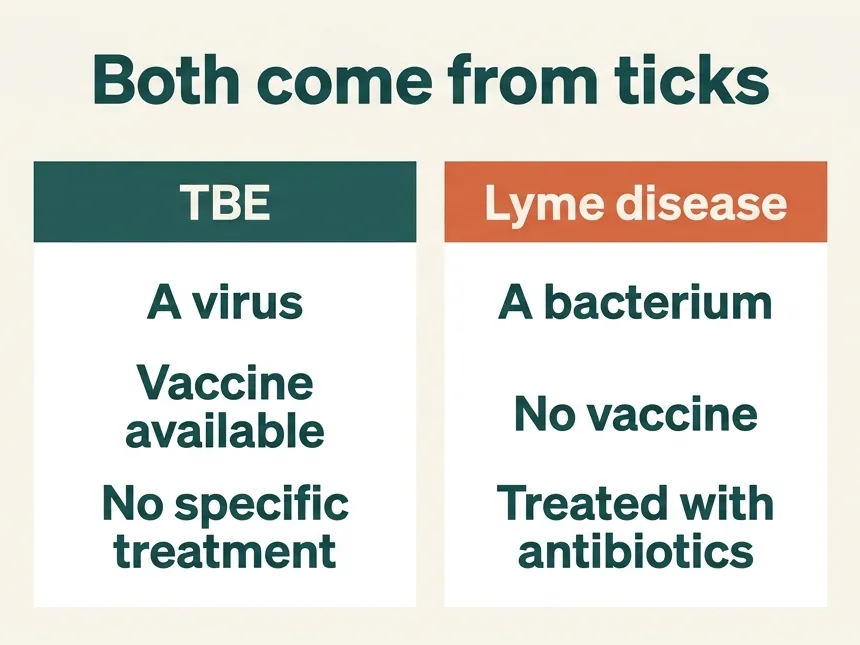
- Both come from tick bites, but Lyme is bacterial and treatable with antibiotics, and there's no vaccine for it. The TBE vaccine doesn't protect against Lyme, so tick precautions still matter.
Where TBE occurs
- Europe and Asia
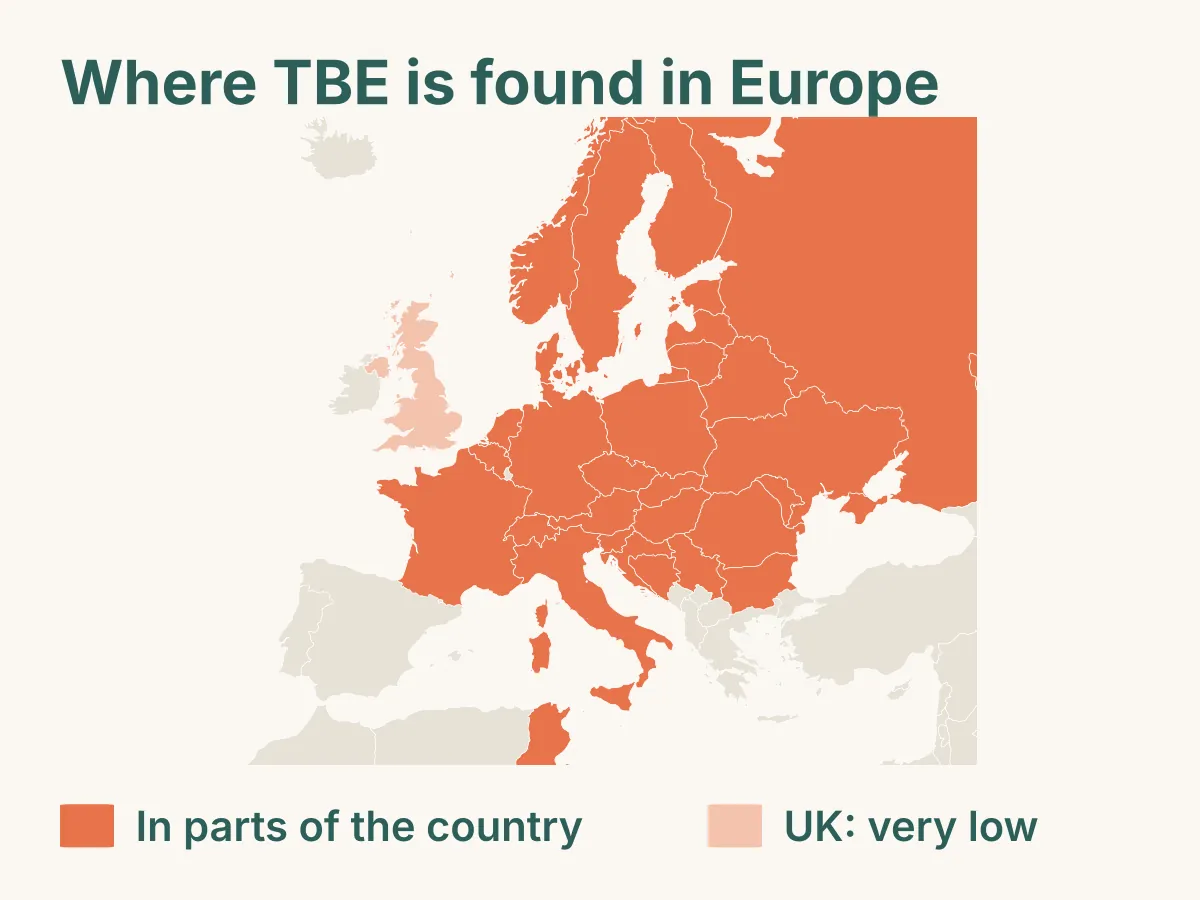
- Parts of central, northern and eastern Europe, through Russia and into parts of Asia. Risk varies sharply within countries, and within a country it can be limited to particular forests and valleys.
- Season
- Early spring through to late autumn in Europe, with the exact season varying by place and altitude.
- Italy in 2025
- 48 cases, 45 of them locally acquired, and one death were reported in Italy in 2025, which surprises people who think of TBE as an eastern European problem.
- In the UK
- TBE is now here in small numbers. As of 17 August 2026, ten locally acquired cases, three confirmed and seven probable, had been reported in Devon, Hampshire, the Outer Hebrides, the Scottish Highlands and Yorkshire. The risk is very low for the general population, and low even for people spending a lot of time outdoors in those areas.
- Check your destination
- The TravelHealthPro country pages give the UK position for each country, and we check them with you.
Who it is for
Who should consider the vaccine
-
Outdoor trips in risk areas
Hiking, camping, trekking, trail running, cycling, fishing, or mushroom and berry picking in forest and grassland during tick season.
-
Living or working there
Anyone living in a risk area, and people whose work takes them outdoors there: farming, forestry, military and field research.
-
Long or repeat trips
Second homes, seasonal work, or regular visits to the same forested region.
-
Laboratory staff
Anyone who may be exposed to the virus at work.
-
Probably not needed
City breaks with no time in forest or grassland. We'll say so if that's your trip.
-
Work it out for your trip
Is TBE vaccine worth it for your trip?
Work it out
Is TBE vaccine worth it for your trip?
Four questions about where you're going, when, and what you'll be doing outdoors.
This works out an answer in your browser. With JavaScript off, the sections below say the same thing in full.
Call us on 020 8393 1000Your answer
- Things about a trip that raise the answer
- 5
- Of those, routes where somebody else pays
- 2
- Rules last checked
- 17 September 2026
This is a guide, not a clinical assessment. Risk varies by region and season, so we check your exact destination at the consultation.
The course
The course, and how fast you can do it
- Standard course
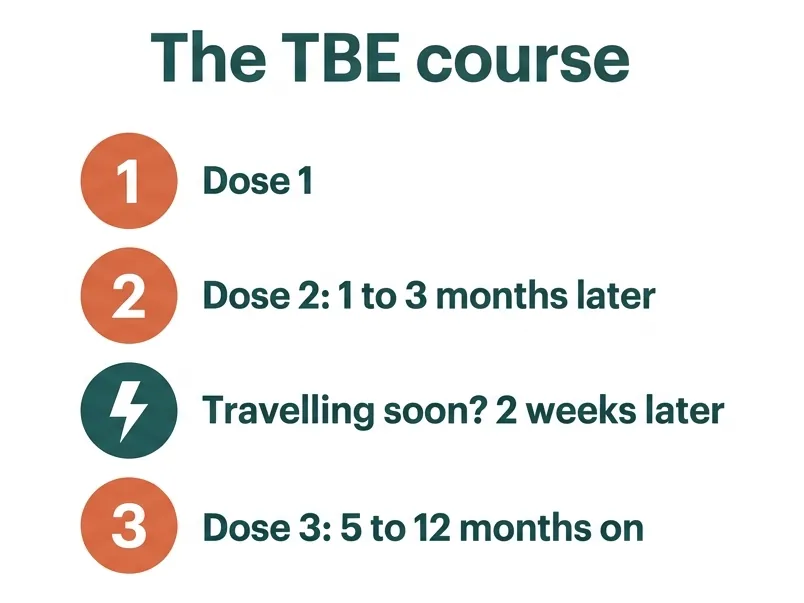
- Three doses: the second one to three months after the first, and the third five to 12 months after the second.
- Two doses cover the season
- Over 90% of people are protected after the second dose, which is enough for the tick season ahead. The third dose is what carries protection on.
- If you're travelling soon
- The second dose can be given two weeks after the first, so a fortnight's notice is enough to get most of the protection.
- Children
- From age 1, using the junior version, on the same schedule.
- Boosters
- The first booster comes no more than three years after the third dose, then every five years while you're still at risk. If you're 60 or over, boosters shouldn't be more than three years apart.
- Best time to start
- Autumn or winter, if you're planning next summer's trip. Nobody does, which is why the two-week schedule exists.
Work it out
Can I be protected in time?
Enter your travel date and this shows which schedule still fits, or plan the doses from a first dose date.
This works out an answer in your browser. With JavaScript off, the sections below say the same thing in full.
Call us on 020 8393 1000Your answer
- I know when I'm travelling
- Whether the standard schedule fits, or the two-week option
- Starting a course
- Every dose date for the schedule you pick, and when protection is expected
- I've had some doses
- What's left and when, without restarting
Dates show timing only. Stock and suitability are confirmed at your consultation.
Avoiding tick bites, and what to do if you're bitten
This protects you against TBE, Lyme disease and everything else ticks carry, and it works whether or not you're vaccinated.
- Cover up
- Long sleeves and trousers tucked into socks in forest and long grass. Light-coloured clothing makes ticks easier to spot.
- Repellent
- Use an effective insect repellent on exposed skin and reapply as directed. Clothing can be treated with permethrin.
- Check daily
- Check your whole body each day, and children more often. Young ticks are tiny and bites don't hurt, so most people never feel one.
- Remove it promptly
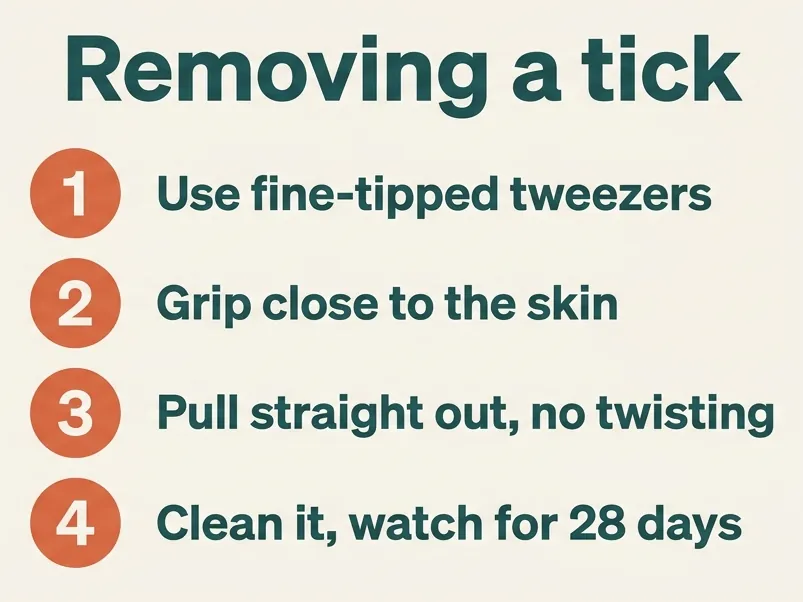
- Use fine-tipped tweezers or a tick removal tool, grip as close to the skin as you can, and pull straight out without twisting or squeezing. Don't use heat, alcohol or petroleum jelly. Clean the area afterwards.
- Avoid unpasteurised dairy
- In risk areas, skip unpasteurised milk, cheese and yoghurt.
- Watch for 28 days
- See a doctor if you feel unwell within 28 days of a tick bite, and mention the bite and where you were. A spreading circular rash is more likely to be Lyme disease, which needs antibiotics.
Safety
Safety and side effects
It isn't live. An inactivated vaccine, so it can't cause the infection, and it's suitable for people with weakened immune systems, though the response may be weaker.
Common side effects. A sore arm, headache, tiredness and muscle aches, and in young children irritability or a mild fever. These usually settle within a day or two.
Who can't have it. Anyone who's had a severe allergic reaction to a previous dose or an ingredient. Tell us about severe egg allergy, as the vaccine is produced using egg protein. Postpone if you're unwell with a fever.
Pregnancy and breastfeeding. It isn't contraindicated, but it's an individual decision based on your risk, and we'll talk it through.
Antibody tests. If you've had yellow fever, Japanese encephalitis or dengue vaccination or infection, antibody tests for TBE can give misleading results. Worth mentioning at the consultation.
Work it out
When's my booster due?
Enter the date of your last dose and this tells you when the next is due: three years after the third dose, then five-yearly, or three-yearly from age 60.
This works out an answer in your browser. With JavaScript off, the sections below say the same thing in full.
Call us on 020 8393 1000Your answer
Put in the date of your last dose and your booster date appears here.
- I know when I had it
- The date your next dose is due, and whether it falls before a trip
Intervals follow the UK guidance. We confirm yours at your consultation.
Your appointment
What the consultation involves
- Bring
- Your destination in detail, including the region, your dates and what you'll be doing outdoors, plus any vaccination records.
- What we do
- Check the current UK guidance for your destination, work out whether the standard or faster schedule fits your dates, and book the doses.
- If you can't finish before you go
- Courses can sometimes be completed abroad. We'll give you a written record so a clinic there can pick up where we left off.
Before you book
Questions about the tick-borne encephalitis (TBE) vaccine
Answered by the pharmacist who signs this page off.
-
Only if you'll be spending time in forest or grassland in a risk area during tick season. City breaks don't need it. Hiking, camping, cycling and fieldwork are when it's worth considering.
The Miles Pharmacy team 94 Chessington Road, Ewell Reviewed 2026-09-17 -
Two doses two weeks apart give over 90% protection for the season ahead, so a fortnight's notice is usually enough.
The Miles Pharmacy team 94 Chessington Road, Ewell Reviewed 2026-09-17 -
Three for the full course: the second one to three months after the first, or two weeks if you're in a hurry, and the third five to 12 months after the second.
The Miles Pharmacy team 94 Chessington Road, Ewell Reviewed 2026-09-17 -
After the third dose, the first booster is due no more than three years later, then every five years while you're at risk. Over 60s need one at least every three years.
The Miles Pharmacy team 94 Chessington Road, Ewell Reviewed 2026-09-17 -
Yes, from age 1, using the junior version.
The Miles Pharmacy team 94 Chessington Road, Ewell Reviewed 2026-09-17 -
No. Lyme is a bacterial infection with no vaccine, treated with antibiotics. Tick bite avoidance is what protects you against both.
The Miles Pharmacy team 94 Chessington Road, Ewell Reviewed 2026-09-17 -
In small numbers. Ten locally acquired cases had been reported as of August 2026, in Devon, Hampshire, the Outer Hebrides, the Scottish Highlands and Yorkshire. Risk to the general population is very low.
The Miles Pharmacy team 94 Chessington Road, Ewell Reviewed 2026-09-17 -
Remove it promptly with fine-tipped tweezers or a tick tool, pulling straight out, then clean the area. See a doctor if you feel unwell within 28 days, and mention the bite.
The Miles Pharmacy team 94 Chessington Road, Ewell Reviewed 2026-09-17 -
Autumn or winter for a trip the following summer, which gives time for the standard schedule. If you've left it later, the two-week option usually still works.
The Miles Pharmacy team 94 Chessington Road, Ewell Reviewed 2026-09-17
Guides and advice
Guides on tick-borne encephalitis (TBE)
-
 Tick-borne encephalitis
Explore the Importance of Tick-Borne Encephalitis Vaccine
-
 Tick-borne encephalitis
How Long Does it Take to Recover from a Tick-borne Illness?
-
 Ears & hearing
Microsuction
Guides are a starting point, not a diagnosis. What is right for you depends on your health history, your medicines and what a pharmacist finds on the day.
Find the pharmacy
Where to come, and when

Ewell, Epsom, Surrey KT19 9UR
How to get here Parking, trains, buses and step-free access
-
The door is on Chessington Road, with step-free access
-
The station car park, on Station Approach off Chessington Road
- Address Elizabeth Court, Station Approach, KT17 1DR
-
Step-free to all platforms, by a footbridge with lifts
- Step-free to every platform (National Rail step-free category A)
- Lifts two, on the footbridge
Checked against nationalrail.co.uk
-
Outside the pharmacy, with a stop on each side of Chessington Road
-
Cycle parking at the station
Take this with you
Point your phone's camera at the code and this page opens there, with the directions one tap away.
Sources
- NaTHNaC: tick-borne encephalitis. Checked .
- NaTHNaC: TBE factsheet. Checked .
- UKHSA Green Book chapter 31: tick-borne encephalitis, dated . Checked .
- NaTHNaC outbreak surveillance: TBE in the United Kingdom, dated . Checked .
- NaTHNaC: insect and tick bite avoidance factsheet. Checked .
Travel health
Book before you pack.
Choose a service and a date that suits you. One of us confirms it with you directly.
- Private and NHS
- GPhC premises 9011598
- Open until 6:30pm
Prefer to talk? 020 8393 1000