Travel vaccination
Hepatitis B Vaccine in Epsom
Hepatitis B spreads through blood and body fluids, and in most adults it clears on its own. The problem is the minority where it doesn't. Chronic hepatitis B can damage the liver for decades before anyone notices, and there's no cure once it takes hold.
- Registered Yellow Fever Vaccination Centre
- GPhC premises 9011598
Recommendations depend on your itinerary, health history and current guidance.

NaTHNaC Registered Yellow Fever Vaccination Centre
A Yellow Fever Vaccination Centre on the NaTHNaC register, and the same travel clinic that gives your other vaccinations.
GPhC registered premises
9011598
Private and NHS pharmacy services from one registered pharmacy in Ewell, Epsom.
In short
Miles Pharmacy in Epsom gives the hepatitis B vaccine at £55 a dose. Most courses are three or four doses, and a very rapid schedule protects adults in about three weeks. It's recommended for travel, many healthcare and skin-piercing jobs, and several health conditions.
- Price
- £55 a dose
Who it is for
Who needs the hepatitis B vaccine for travel
Travel risk comes from what you do and where you might need medical care, more than from where you stay.
-
Long stays
Anyone planning to live or stay for a long time in a higher-prevalence area.
-
Visiting family
Children and adults visiting relatives, who might need a doctor or dentist while they're away. Typhoid vaccination is often needed for the same trips.
-
Medical or dental care abroad
Travelling for treatment, or living with a condition such as kidney disease that might need hospital care overseas. Unsterile equipment is a real transmission route in some places.
-
What you'll be doing
New sexual partners, relief healthcare work, contact and combat sports, tattoos or piercings abroad. On Hajj and Umrah, the head-shaving rite is a reason to consider it, and Saudi Arabia asks pilgrims for the Umrah vaccine too.
-
Work it out for your trip
Do you need the hepatitis B vaccine?
Work it out
Do you need the hepatitis B vaccine?
Covers travel, work, health reasons and whether you're already protected. It'll also tell you when someone else should be paying.
This works out an answer in your browser. With JavaScript off, the sections below say the same thing in full.
Call us on 020 8393 1000Your answer
- Jobs the guidance names
- 8
- Health reasons it covers, travel or not
- 10
- Of those, routes where somebody else pays
- 16
- Things about a trip that raise the answer
- 7
- Rules last checked
- 17 September 2026
This is a guide, not a clinical assessment. We confirm the right schedule and check your records at your appointment.
Where it is common
Where hepatitis B is common
WHO estimates around 240 million people worldwide are living with long-term hepatitis B. Most of them are in two parts of the world, and most don't know they have it.
Living with long-term hepatitis B, by WHO region
- Western Pacific
- around 102 million
- Africa
- around 64 million
- South-East Asia
- around 43 million
- Eastern Mediterranean
- around 16 million
- Europe
- around 9.7 million
- Americas
- around 5 million
WHO estimates, rounded. Around 240 million worldwide. Source: WHO Global hepatitis report 2026.
- The highest rates
- WHO's latest country estimates put more than one in ten people living with hepatitis B in Mali, Sierra Leone, Guinea-Bissau, the Central African Republic, Cameroon, Benin, Cabo Verde, Lesotho, Niger, Côte d'Ivoire and Guinea. Most of West and Central Africa is high.
- Asia and the Pacific
- Several Western Pacific countries have rates above 5%, including Vietnam, Indonesia, the Philippines and the Solomon Islands.
- Broader picture
- WHO counts 96 countries where more than 2% of people live with hepatitis B, home to around two thirds of the world's population. By contrast the UK, most of Western Europe and North America are well under that.
- UK guidance bands
- UK guidance groups sub-Saharan Africa, most of Asia and the Pacific islands as high, and the Indian subcontinent, the Middle East, the Amazon and southern parts of Eastern and Central Europe as intermediate.
- Check your own destination
- WHO publishes a hepatitis profile for every country, which is the most reliable place to check a destination we don't have a page for.
- Common locally isn't the same as your risk
- Hepatitis B spreads through blood and sex, not food or water, so a country's rate matters less than what you'll be doing there. That's why it's recommended for some travellers rather than most, even for countries with high rates. Our destination pages say which applies for each country.
- If you were born in one of these regions
- Many people pick up hepatitis B at birth or in early childhood, often without symptoms. If that might be you, a blood test can show whether you're already immune or need specialist care, and it's free through your GP.
While you are away
Staying safe while you're away
Vaccination is one part of it. These cut the risk from hepatitis B and a lot of other blood-borne infections, vaccinated or not.
-
Sex
Use condoms with any new partner. They protect against hepatitis B and other infections the vaccine doesn't cover.
-
Tattoos, piercings and cosmetic treatments
Where equipment may not be sterile, wait until you're home. The same goes for acupuncture, cupping that breaks the skin, and cosmetic injections.
-
Medical and dental treatment
If you need an injection, a drip or dental work, ask for new, sealed equipment. For long trips or remote areas, a small sterile medical kit is worth carrying.
-
Everyday items
Don't share razors, toothbrushes or nail scissors, including with family you're staying with.
-
Sport and injuries
Cover cuts and grazes, particularly in contact sports, and clean any wound quickly.
-
If something happens
After a needle injury, a bite that breaks the skin or unprotected sex with someone who might have hepatitis B, wash the area and get medical advice where you are. Tell your GP when you're back, as a follow-up test may be needed.
For work
Hepatitis B for work
This is where most private hepatitis B demand actually comes from, and where the antibody test matters as much as the vaccine.

- Healthcare workers, students and trainees
- Anyone with direct contact with patients' blood, blood-stained fluids or tissues, or at risk of sharps injuries or bites. That includes nursing, medical, dental and allied health students before placements, agency and bank staff, and overseas-trained staff joining UK employers. Many employers and universities pay for it, but a lot of people end up arranging it themselves. Our hepatitis B vaccine for work page sets out what an employer has to arrange and pay for.
- Social care staff who use needles
- Adult social care staff who regularly use needles or lancets on clients, following an occupational health risk assessment.
- Tattoo artists, piercers, morticians and embalmers
- Any job that routinely involves needles puncturing skin. Usually self-funded, and often asked for by licensing or insurers.
- Laboratory staff
- Anyone handling material that may contain the virus.
- Learning disability settings
- Staff in residential, day-care and school settings where biting or scratching is likely, based on a local risk assessment.
- Prison, police, fire and rescue
- Prison staff in regular contact with prisoners, and emergency services staff who frequently handle discarded needles, following a risk assessment.
- Combat sports
- Boxers, MMA fighters and wrestlers with regular exposure to blood during bouts.
Not only travel
Health reasons and close contacts
UK guidance recommends hepatitis B vaccination for these groups whether or not they travel. Most can get it free through the NHS, and we'll point you there rather than charge you.
- Sexual health
- People who change sexual partners frequently, gay and bisexual men, and sex workers. Sexual health clinics provide it free.
- People who inject drugs
- Along with their partners, children and household. Drug services and GPs provide it.
- Partners and household of someone with hepatitis B
- Vaccination with a blood test at the first dose to check for past infection. This is an NHS route.
- Adoption and fostering
- Families adopting a child from a country where hepatitis B is common, and short-term foster carers taking emergency placements, along with their families.
- Kidney disease, liver disease and transplants
- People with advanced kidney disease or on dialysis, anyone with chronic liver disease including hepatitis C, and people waiting for an organ transplant. These are usually managed by the specialist team, sometimes with vaccines designed for kidney failure.
- Blood products and HIV
- People receiving regular blood or blood products and their carers, and people living with HIV, who may need extra doses.
Before you book
You might already be protected
-
Born in the UK on or after 1 August 2017
Hepatitis B has been part of the routine 6-in-1 baby vaccine since 2017. Children who had their baby jabs are usually already covered for travel. Bring their red book and we'll check it before you pay for anything.
-
Completed a course before
Healthy people who've finished a course and responded aren't usually offered a booster, for travel or for work. Bring your records and we'll check at your appointment.
-
Past infection
If you've had hepatitis B and cleared it, you're usually protected. A blood test can confirm it, and we'll talk it through at your appointment.
-
Partly done a course
Carry on from where you stopped. A course is resumed, never restarted, however long the gap.
The course
Which schedule, and what it costs
We use two hepatitis B vaccines, both given as an injection into the upper arm. There are several ways to give the course, and the right one depends on how soon you need protection and how reliably you can come back.
- The vaccines we use
- Two hepatitis B vaccines. Both protect against hepatitis B in the same way, and both are given as an injection into the upper arm.
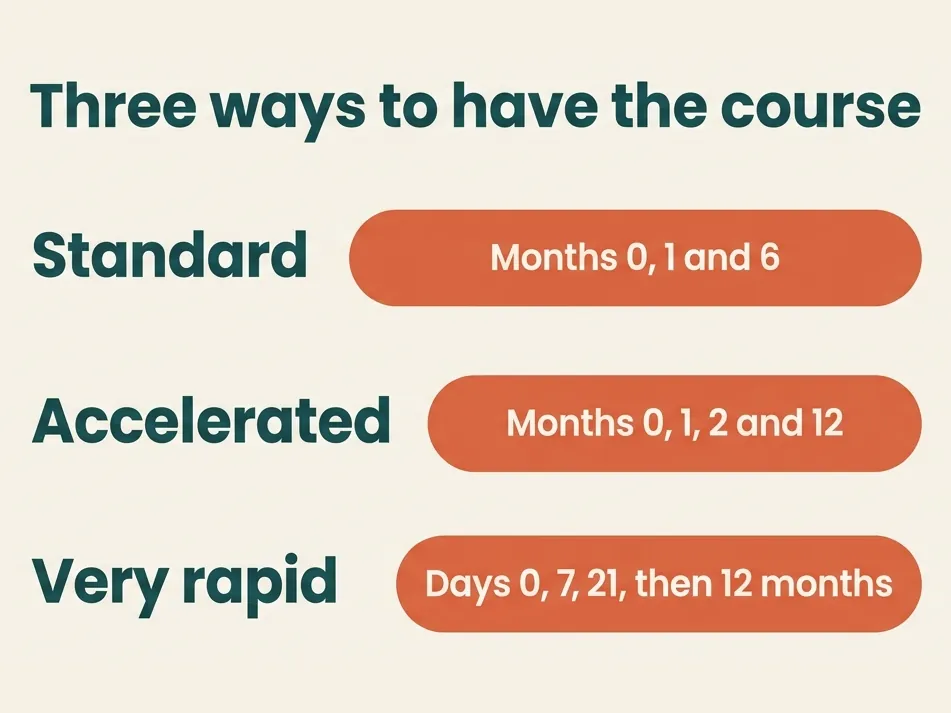
- Standard: 0, 1 and 6 months
- Three doses, £165. The best response for people who aren't in a hurry.
- Accelerated: 0, 1, 2 and 12 months
- Four doses, £220. The most commonly used schedule in the UK. You're protected after the first three, and the fourth at 12 months completes the course.
- Very rapid: days 0, 7 and 21, then 12 months
- Four doses, £220. Not every hepatitis B vaccine is licensed for this schedule, so which one we use is decided by the schedule rather than by preference. For adults travelling soon or at immediate risk. The 12-month dose is what gives long-term protection, so it isn't optional.
- Two doses for ages 11 to 15
- Two adult-strength doses six months apart, £110.
- If you need hepatitis A too
- We give hepatitis A and hepatitis B as separate injections, usually at the same appointment, one in each arm. Combined hepatitis A and B vaccines exist, but we don't use them here.
What it costs
£55 a dose
| Schedule | What that covers | Price |
|---|---|---|
| Standard | 3 doses, £55 each | £165 |
| Accelerated | 4 doses, £55 each | £220 |
| Very rapid | 4 doses, £55 each | £220 |
| Ages 11 to 15 | 2 doses, £55 each | £110 |
One price, paid when you book.
Work it out
Plan your doses
Pick a schedule and a start date, and this lays out every dose, when you're protected, and when an antibody test would be due if you need one.
This works out an answer in your browser. With JavaScript off, the sections below say the same thing in full.
Call us on 020 8393 1000Your answer
- I know which schedule
- Every dose date, the date protection is expected, and the antibody test window if relevant
- I need protection by a date
- Which schedules finish in time, with the fastest shown first and the 12-month dose flagged
- I've had some doses
- What's left and when, without restarting
Dates follow the UK schedules in the Green Book. We'll confirm the right one for you at your appointment.
Antibody testing
Antibody testing: who needs it and when
- Who
- Healthcare and laboratory workers, people with kidney failure, and some people with weakened immune systems. It isn't routinely needed for travel.
- When
- One to two months after the final dose of the course. Testing earlier doesn't tell you anything useful, because you may still respond to the last dose.
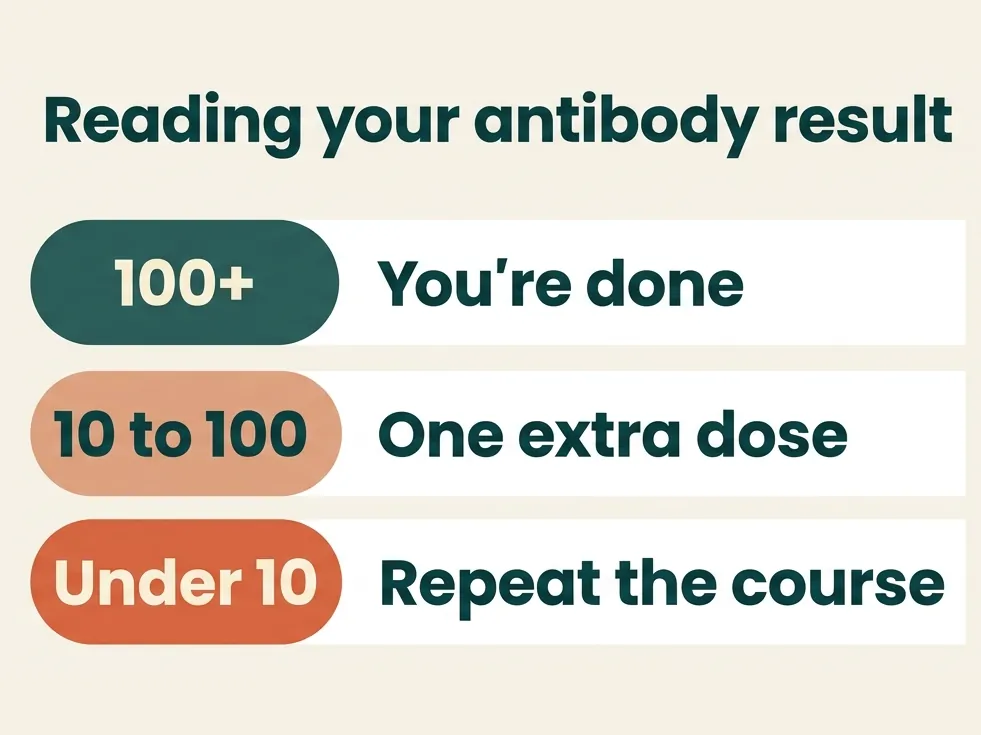
- Reading the result
- At 100 or more, you're done: no further doses or tests. Between 10 and 100, one extra dose and no more testing. Under 10, the next step is checking for past infection and repeating the full course, then testing again.
- If you missed the test
- Healthcare workers who never had their antibodies checked after the course should be tested now and managed on the result.
- Why it matters at work
- Under COSHH regulations you have a right to know whether you're protected, and it decides what happens after a needlestick injury.
If it has already happened
Think you've been exposed?
This isn't a booking. It's same-day advice.
Call us on 020 8393 1000What counts. A needlestick or sharps injury, a bite that broke the skin, blood splashed into your eyes or mouth, or unprotected sex with someone who has hepatitis B.
Right now. Wash the area with soap and warm water. Don't scrub or suck the wound.
Then. Get advice today from A&E, NHS 111 or your occupational health service. Vaccination works best within 24 hours and can still help up to a week afterwards, sometimes with immunoglobulin as well.
Safety
Safety and side effects
- Who can't have it
- Very few people. Only those who've had a confirmed severe allergic reaction to a previous dose or to a vaccine component.
- Common side effects
- A sore, red arm, headache and tiredness for a day or two. Mild fever and a flu-like feeling are less common.
- Pregnancy and breastfeeding
- It's an inactivated vaccine. It should be given in pregnancy where there's a definite risk, and it's fine while breastfeeding.
- Multiple sclerosis
- This comes up. Large studies have looked for a link between hepatitis B vaccination and MS, and the evidence doesn't support one.
- If you don't respond
- About one in ten adults don't make enough antibody. It's more likely over 40, with obesity, smoking, kidney disease or a weakened immune system, which is why testing matters for people at work risk.
Your appointment
What the appointment involves
- Bring
- Any vaccination records, including a child's red book and records from abroad, plus any letter from your employer or university saying what they need.
- Planning the dates
- We'll book your follow-up doses before you leave, so the course doesn't drift.
- Alongside other vaccines
- Hepatitis B can be given at the same appointment as any other vaccine, including hepatitis A, in a different arm.
Before you book
Questions about the hepatitis B vaccine
Answered by the pharmacist who signs this page off.
-
£55 per dose. That's £165 for the three-dose standard course, £220 for the four-dose accelerated or very rapid schedules, and £110 for the two doses for ages 11 to 15.
-
Usually three or four, depending on the schedule. Children aged 11 to 15 can have two adult-strength doses six months apart.
-
On the very rapid schedule, adults are protected about three weeks after starting. Other schedules take one to two months. You aren't fully protected after one or two doses.
-
Healthy people who've finished a course and responded aren't usually offered a booster, for travel or for work. Boosters are only considered for kidney failure, after a significant exposure, or for healthcare workers who didn't respond. Bring your records and we'll check at your appointment.
-
No. Pick up where you left off, however long ago it was. The course is resumed, never restarted.
-
Hepatitis B has been in the routine 6-in-1 baby vaccine since August 2017, so children who had their baby jabs are usually already covered for travel. Bring their red book and we'll check it before you pay for anything.
-
A full course and an antibody test one to two months after the last dose. Check whether your university or employer pays first, and bring any paperwork they've given you.
-
Many people can, including those at sexual health risk, people who inject drugs, household contacts of someone with hepatitis B, and people with kidney or liver disease. Travel and most private occupational vaccination isn't covered. We'll tell you if you qualify rather than charge you.
-
Don't wait for an appointment. Wash the area and get advice today from A&E, NHS 111 or your occupational health service. Vaccination works best within 24 hours.
-
No. Large studies have looked for a link and the evidence doesn't support one.
-
WHO's latest country estimates put more than one in ten people living with hepatitis B in Mali, Sierra Leone, Guinea-Bissau, the Central African Republic, Cameroon, Benin, Cabo Verde, Lesotho, Niger, Côte d'Ivoire and Guinea. By region, the Western Pacific and Africa carry the largest numbers. Whether you need the vaccine depends more on what you'll be doing than where you're going.
-
We use two hepatitis B vaccines, both given as an injection into the upper arm and both protecting in the same way. Which one you have depends on your age and the schedule that suits you, and not every vaccine is licensed for the very rapid schedule. We will tell you which one you are having at your appointment, and it goes on your record.
-
Not here. We give them as two separate injections, usually at the same appointment.

Guides and advice
Guides on hepatitis B
-
 Hepatitis B
 vaccine schedules: how quickly can you be protected?
-
 Hepatitis B
Do you need the hepatitis B vaccine for travel?
-
 Ears & hearing
Microsuction
Guides are a starting point, not a diagnosis. What is right for you depends on your health history, your medicines and what a pharmacist finds on the day.
Find the pharmacy
Where to come, and when
Miles Pharmacy is in Epsom, Surrey. Patients come to us from across Surrey, including Ewell, Ashtead, Leatherhead and Banstead, and from Sutton, Cheam, Surbiton and Kingston in south-west London.

Ewell, Epsom, Surrey KT19 9UR
How to get here Parking, trains, buses and step-free access
-
The door is on Chessington Road, with step-free access
-
The station car park, on Station Approach off Chessington Road
- Address Elizabeth Court, Station Approach, KT17 1DR
-
Step-free to all platforms, by a footbridge with lifts
- Step-free to every platform (National Rail step-free category A)
- Lifts two, on the footbridge
Checked against nationalrail.co.uk
-
Outside the pharmacy, with a stop on each side of Chessington Road
-
Cycle parking at the station
Take this with you
Point your phone's camera at the code and this page opens there, with the directions one tap away.
Sources
- UKHSA Green Book chapter 18: hepatitis B, dated . Checked .
- NaTHNaC hepatitis B factsheet. Checked .
- UKHSA: bloodborne viruses in healthcare workers. Checked .
- WHO hepatitis B fact sheet, dated . Checked .
- WHO Global hepatitis report 2026. Checked .
- WHO: Hepatitis B and C burden, gaps and priorities (World Hepatitis Day 2025, country estimates for 2022), dated . Checked .
- WHO hepatitis country profiles dashboard. Checked .
Travel health
Book before you pack.
Choose a service and a date that suits you. One of us confirms it with you directly.
- Private and NHS
- GPhC premises 9011598
- Open until 6:30pm
Prefer to talk? 020 8393 1000