
The fastest hepatitis B vaccine schedule gives adults three doses in three weeks, on day 0, day 7 and day 21. The accelerated schedule gives protection after doses at 0, 1 and 2 months, and the standard schedule of 0, 1 and 6 months suits anyone who isn’t in a hurry. The two faster schedules need a final dose at 12 months for long-term protection. You can book your hepatitis B vaccine in Epsom with us.
The three schedules side by side
| Schedule | Doses | Protection | Price at Miles |
|---|---|---|---|
| Very rapid | Days 0, 7 and 21, then 12 months | The quickest course, for adults at immediate risk | £220 |
| Accelerated | 0, 1 and 2 months, then 12 months | Expected after the first three doses | £220 |
| Standard | 0, 1 and 6 months | After the course, when protection isn’t needed quickly | £165 |
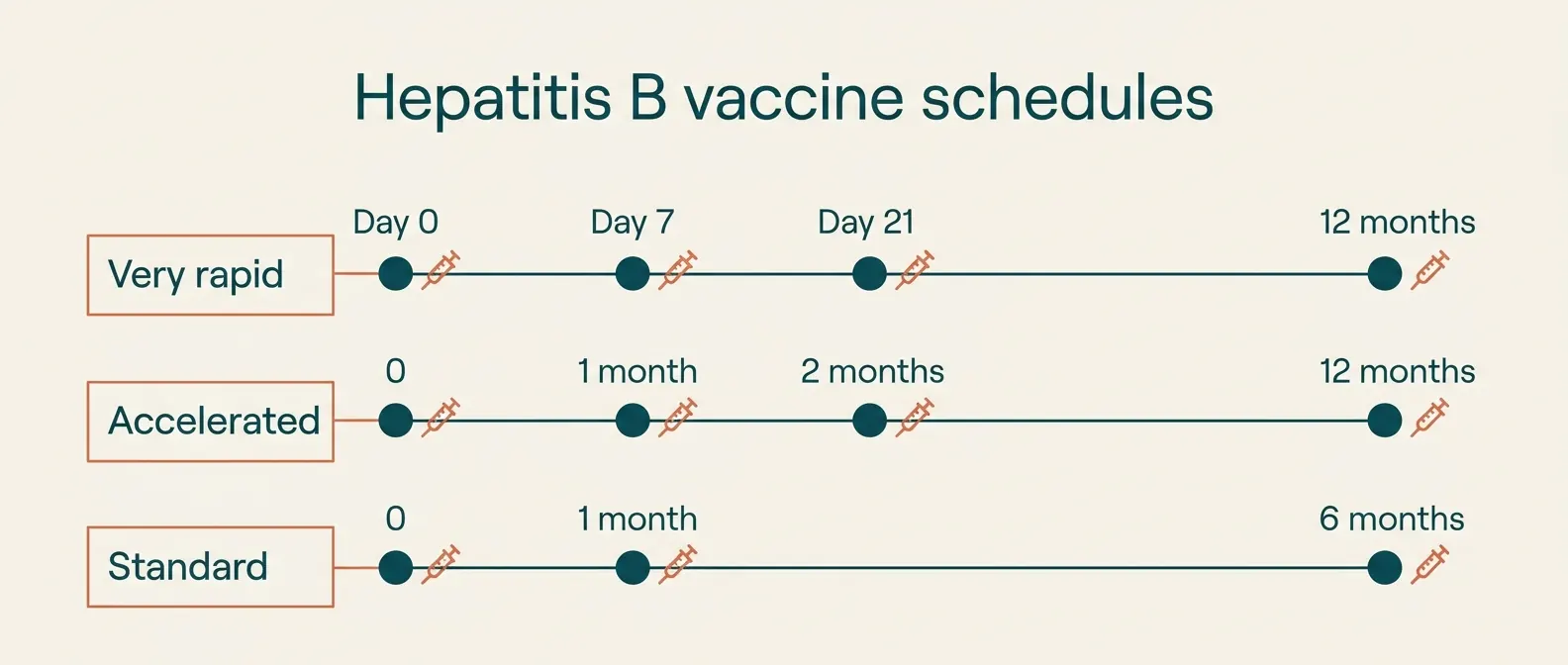
Very rapid: three doses in three weeks
Doses on day 0, day 7 and day 21. It’s licensed for adults who are at immediate risk and need protection quickly, and UK guidance allows it from 16 where rapid protection is important. Not every hepatitis B vaccine is licensed for this schedule, so the schedule decides which one you’re given.
Accelerated: the one most people have
UK guidance recommends the accelerated schedule for most adults and children at risk. Doses at 0, 1 and 2 months give protection, and the dose at 12 months makes up for the shorter gaps.
Standard: when there’s no rush
Doses at 0, 1 and 6 months. UK guidance keeps it for people who don’t need protection quickly and are likely to come back for every dose.
Which fits your date?
| Time until you travel or start work | Schedule that fits |
|---|---|
| 3 weeks or more | Very rapid (adults), with the 12-month dose when you’re back |
| About 2 months or more | Accelerated, with the 12-month dose later |
| 6 months or more | Standard |
| Less than 3 weeks | Talk to us: starting now means fewer doses left to have when you’re back |
One or two doses don’t give full protection, so plan to finish the first part of the course before you go. If hepatitis A is on your list too, it works very differently: one dose before you fly still counts. Our guide to the hepatitis A vaccine at the last minute explains.
Why the 12-month dose matters
On the very rapid schedule, UK guidance says a fourth dose should be given 12 months after the first for longer-term protection. On the accelerated schedule, the 12-month dose makes up for the shorter gaps between the first three. Book it when you have your first dose so it doesn’t slip.
If a dose is late
You don’t start again. UK guidance says an interrupted course should be resumed, not repeated, however long the gap. Bring any record you have, including one from another country, and the pharmacist will pick up where you left off.
Children
Aged 11 to 15
Two adult-strength doses, six months apart, give similar protection to three children’s doses. At Miles that’s £110.
Born on or after 1 August 2017
Hepatitis B has been part of the routine 6-in-1 baby vaccine since 2017, so children who had their baby jabs have already had it. Bring their red book and the pharmacist will check where they stand.
How well it works
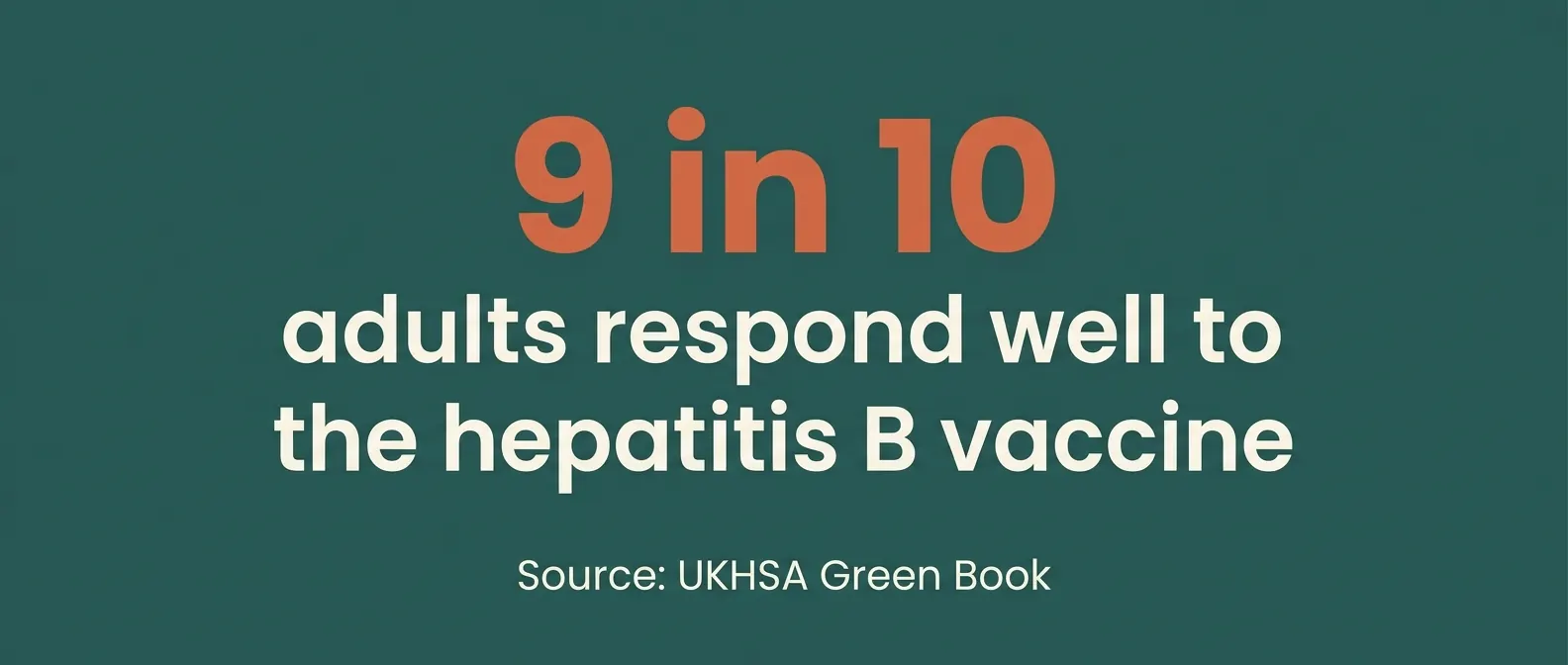
Around 90% of adults respond well to the vaccine, and over 98% of babies. A weaker response is more likely over the age of 40, and with obesity or smoking. For people who respond, protection against long-term infection lasts 20 to 30 years or more.
Side effects and safety
What’s common
A headache, tiredness, and soreness or redness where the injection went in. Some people feel sick, have a high temperature, or have an upset stomach. A severe allergic reaction is very rare.
Who shouldn’t have it
Anyone who has had a confirmed severe allergic reaction to a previous dose or to anything in the vaccine. If you have a fever, wait until you’ve recovered; a minor illness without a fever is no reason to put it off.
Pregnancy, breastfeeding and MS
UK guidance says it should be given in pregnancy where there’s a definite risk of infection, and there’s no evidence of risk from vaccinating women who are breastfeeding. Many studies have looked for a link between the hepatitis B vaccine and multiple sclerosis, and the weight of evidence doesn’t support one.
Starting your course in Epsom
We’re at 94 Chessington Road, Ewell, Epsom, KT19 9UR, with a bus stop outside and Ewell West station nearby. Whether you’re in Epsom or coming from Sutton, Cheam or Banstead, we’ll book your later doses before you leave, so the course doesn’t drift. Call us on 020 8393 1000.
Questions about hepatitis B schedules
How many hepatitis B jabs do I need?
Three on the standard schedule, or four on the accelerated and very rapid schedules, counting the 12-month dose. Children aged 11 to 15 can have two adult-strength doses.
How long before travel should I start?
At least three weeks for the very rapid schedule if you’re an adult, about two months for the accelerated one, and six months for the standard one. Earlier is easier. Our guide to the hepatitis B vaccine for travel covers who it’s recommended for.
I missed my second dose. Do I start again?
No. The course is resumed, not repeated, however long ago your last dose was.
Do I really need the 12-month dose?
On the very rapid and accelerated schedules, yes: it’s the dose that gives longer-term protection.
Can I have it with hepatitis A or other travel vaccines?
Yes. They can be given at the same appointment, as separate injections, one in each arm.
Will I need a booster later?
Most healthy people who respond to the course have no routine booster. Our guide to hepatitis B boosters explains who is offered one.
Sources
- UKHSA: the Green Book, chapter 18, hepatitis B (updated 24 February 2026), checked 2 October 2026
- NHS: hepatitis B vaccine, checked 2 October 2026
- UKHSA: the Green Book, chapter 17, hepatitis A, checked 2 October 2026
- UKHSA: hexavalent (6-in-1) vaccine programme guidance, checked 2 October 2026