
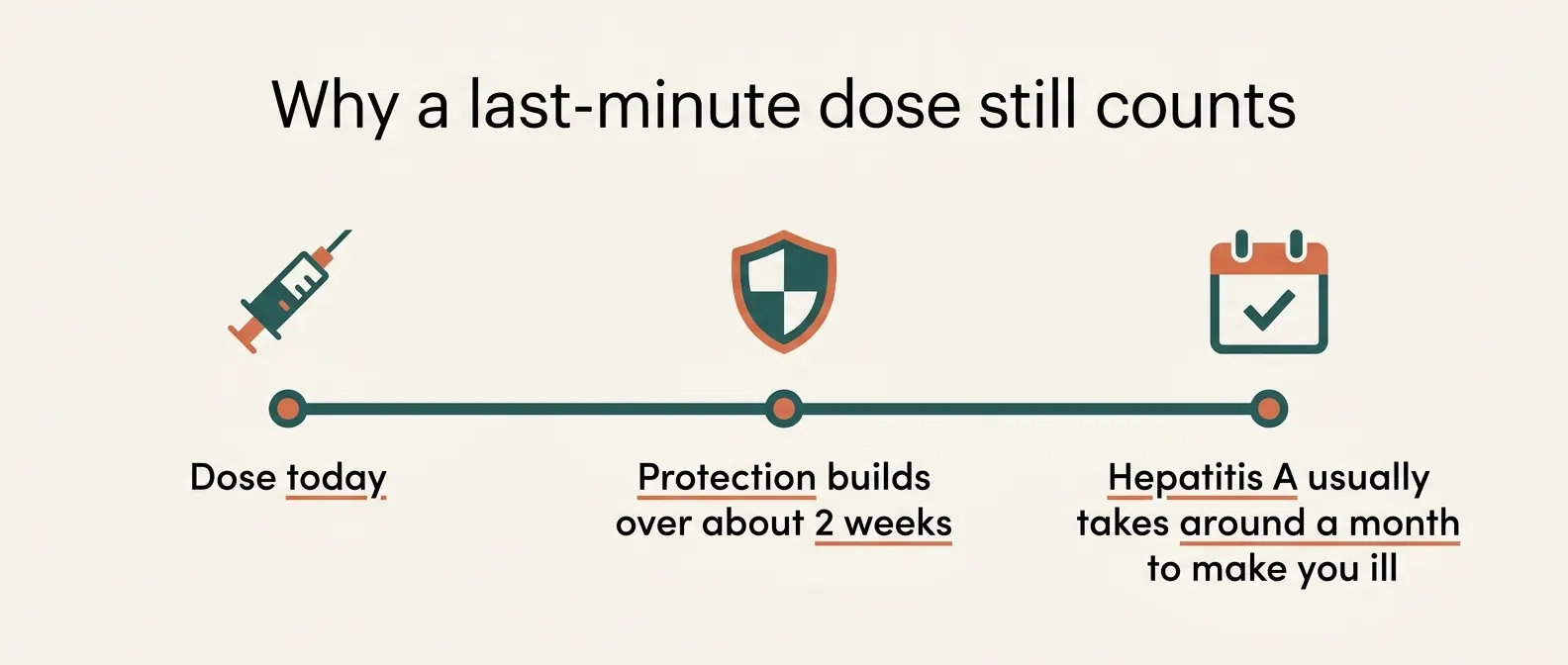
It’s not too late. There’s no minimum notice for the hepatitis A vaccine: it can be given right up to the day you travel. Protection builds over about two weeks, and hepatitis A usually takes around a month to make you ill after you catch it, so a dose the day before you fly is still worth having. You can book your hepatitis A vaccine in Epsom with us.
How long before travel should you have it?
UK guidance is to have it at least two weeks before you go if you can, but it can be given up to the day you leave. So if you’re flying sooner than that, have it anyway.
If you need other travel vaccines too, the NHS suggests getting advice four to six weeks before you travel, because some of them need more than one dose. The hepatitis A vaccine can be given at the same appointment as other travel vaccines.
How the course works
Two doses
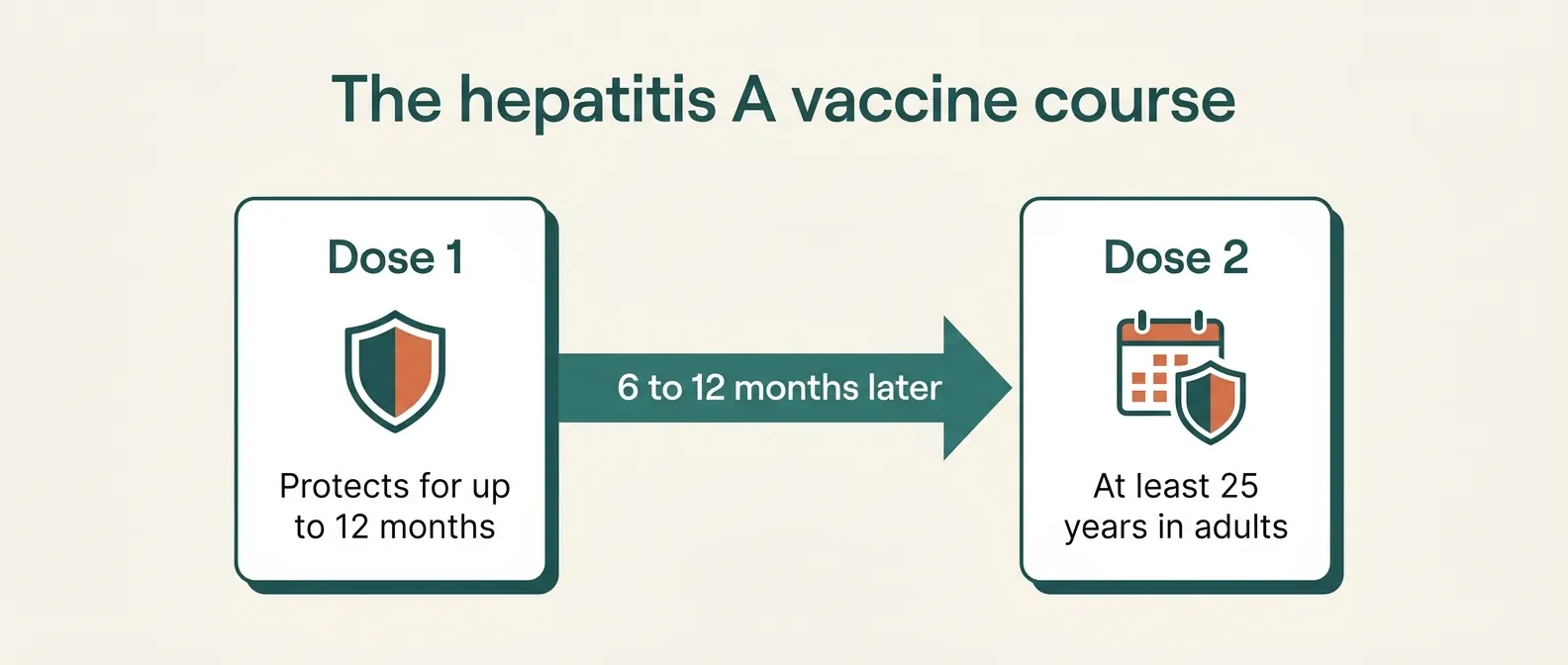
The course is two doses, with the second six to twelve months after the first.
How long it lasts
One dose protects you for up to 12 months. A full two-dose course gives long-lasting protection, for at least 25 years in adults, and may give lifelong immunity. If you’re still at risk 25 years on, a booster is recommended. Our guide to how long the hepatitis A vaccine lasts goes into more detail.
Leaving it late
Have the first dose before you go and the second when you’re back. That’s the normal course, not a compromise: the second dose isn’t due until six to twelve months later anyway.
If the second dose ends up later than that, it still counts. There’s no maximum gap between the doses, and the course never needs restarting.
What about immunoglobulin?
Current UK guidance no longer recommends immunoglobulin injections for travel. The vaccine is what’s used.
Who it’s recommended for
Hepatitis A remains one of the most common travel-related infections that a vaccine can prevent. Of the 713 confirmed cases in England and Wales in 2024, 403 had travelled.
Where you’re going
It’s recommended for most unvaccinated travellers to South Asia, sub-Saharan and North Africa, the Middle East, Central and South America, and parts of the Far East apart from Japan. Our guide to which countries you need the hepatitis A vaccine for goes country by country.
Heading to Kenya? Our Kenya travel health video covers hepatitis A alongside malaria tablets and the yellow fever vaccine.
Visiting friends and family

People travelling to visit friends and relatives are among the travellers at higher risk.
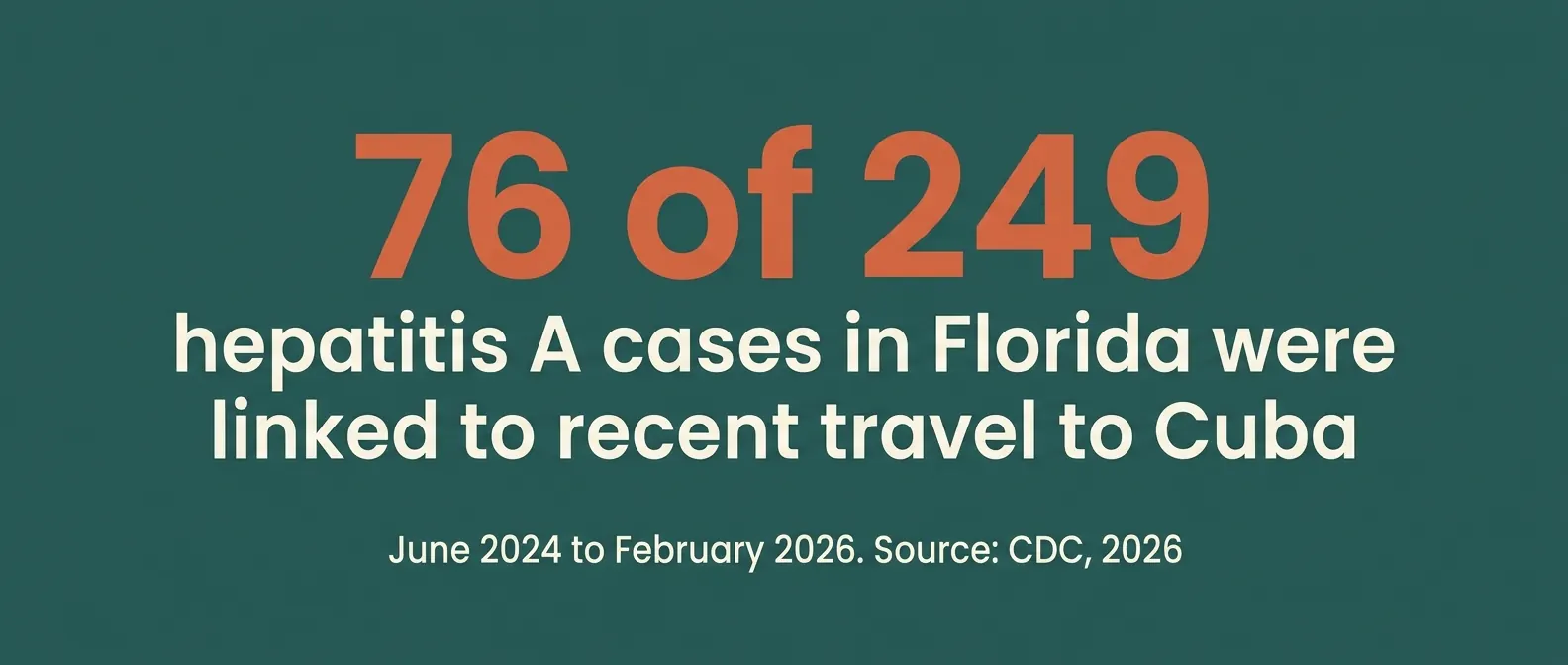
A 2026 report from the US shows why. Between June 2024 and February 2026, 76 of the 249 hepatitis A cases reported in Florida were linked to recent travel to Cuba. Of the travellers who said where they’d stayed, almost all had stayed only with family and friends.
Staying somewhere good
A good hotel lowers the risk, but it doesn’t remove it. Cases have occurred in tourists staying in good quality hotels.

Food and water
Even with the vaccine, take care with what you eat and drink while you’re away.
Children
The vaccine can be given from 12 months old.
Before and after the injection
Side effects
The common ones are soreness, redness or swelling where the injection went in. Less often, people have a headache, tiredness, a slight temperature or loss of appetite. They’re usually mild and short-lived. Our guide to hepatitis A vaccine side effects covers what’s normal and when to get help.
Who shouldn’t have it
Anyone who’s had a severe allergic reaction to a previous dose of a hepatitis A vaccine, or to anything in the vaccine. If that’s you, tell us when you book and the pharmacist will talk it through.
If you’re unwell
If you have a fever, wait until you’ve recovered. A cold without a fever is no reason to put it off.
Earlier doses, or hepatitis A in the past
Bring any record you have, including one from another country, and the pharmacist will work out where you stand.
What it costs
£160 for the two-dose course, or £80 per dose.
Flying soon from around Epsom?
We’re at 94 Chessington Road, Ewell, Epsom, KT19 9UR, with a bus stop outside and a car park at Ewell West station nearby. Whether you’re in Epsom or coming from Kingston, Surbiton or Leatherhead, call us on 020 8393 1000 to book before you fly.
Questions about the hepatitis A vaccine
I fly tomorrow. Is it worth having?
Yes. It can be given up to the day you travel. Protection builds over about two weeks, and hepatitis A usually takes around a month to make you ill, so a dose now is still worth having.
Do I need it if I’m staying in a good hotel?
It’s recommended whatever the standard of your stay. A good hotel lowers the risk without removing it, and cases have occurred in tourists staying in good quality hotels. Bring your itinerary and the pharmacist will go through it with you.
I had my first dose years ago. Do I start again?
No. There’s no maximum gap between the doses, so the course never needs restarting. Bring your record and the pharmacist will pick up where you left off.
Can I have it at the same time as other travel vaccines?
Yes. UK guidance says it can be given at the same time as other travel vaccines, so if you need more than one, we can do them at the same appointment.
How long does one dose last?
Up to 12 months. The second dose, six to twelve months after the first, gives long-lasting protection: at least 25 years in adults, and it may be lifelong.
Can my child have it?
The vaccine can be given from 12 months old. Book an appointment and the pharmacist will go through it with you.
Sources
- NaTHNaC: hepatitis A factsheet, checked 2 October 2026
- UKHSA: the Green Book, chapter 17, hepatitis A, checked 2 October 2026
- WHO: hepatitis A vaccines position paper, 2022 (summary), checked 2 October 2026
- NHS: travel vaccinations, checked 2 October 2026
- CDC: hepatitis A outbreak among travellers to Cuba, 2026, checked 2 October 2026
- UKHSA: laboratory reports of hepatitis A infections in England and Wales, 2024, checked 2 October 2026