
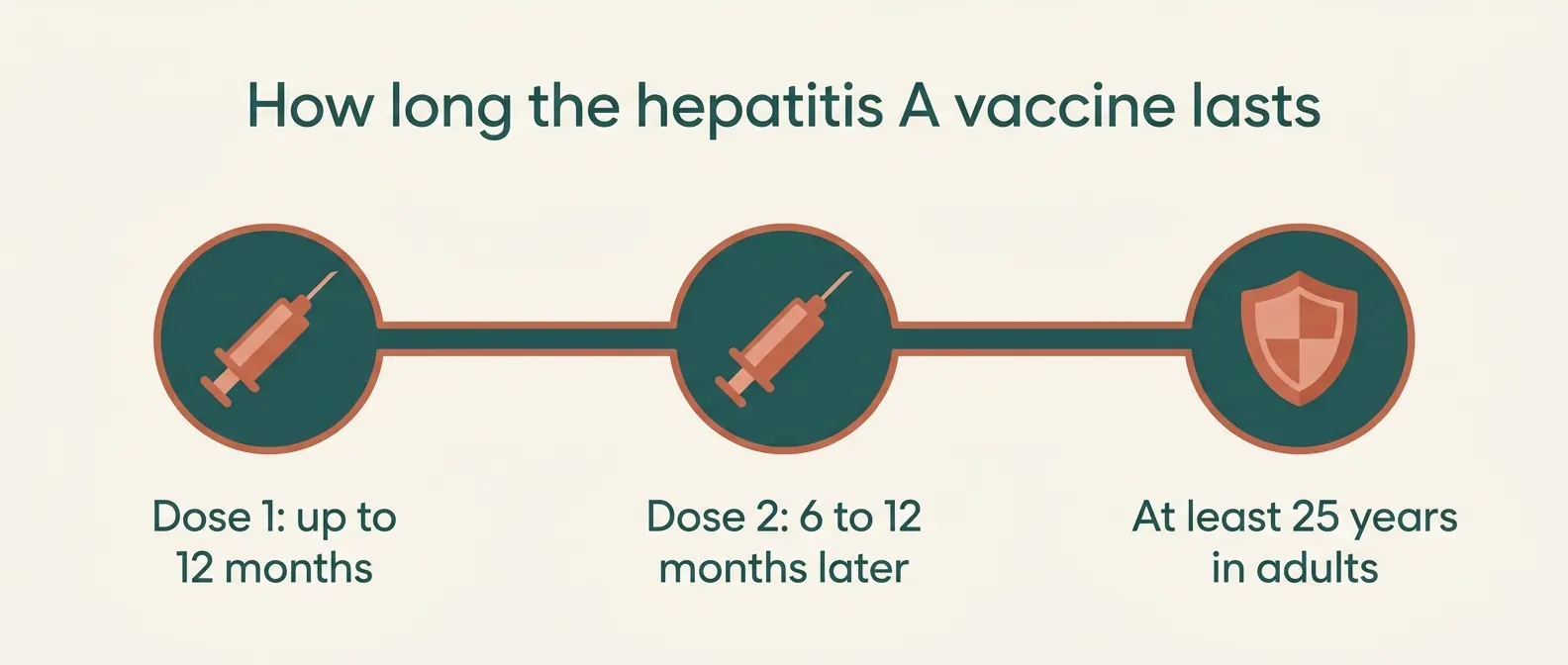
One dose of the hepatitis A vaccine protects you for up to 12 months. A second dose, six to twelve months later, gives long-lasting protection: at least 25 years in adults, and it may be lifelong. If your second dose is late, even by years, the course doesn’t need to start again. You can book your hepatitis A vaccine in Epsom with us.
One dose: up to 12 months
A single dose covers you for up to 12 months. That’s why you can travel on one dose and have the second when you’re back. For protection beyond that, you need the second dose.
Two doses: at least 25 years
The second dose is due six to twelve months after the first. It gives a big boost to your antibodies and long-lasting protection, for at least 25 years in adults. UK estimates suggest up to 95% of people still have protective antibodies 25 years on.
The World Health Organization describes the protection as long-lasting and possibly lifelong. Studies of adults given the two-dose course have found their antibodies still there at least 17 years later.
Where you stand
| Your situation | What it means |
|---|---|
| One dose | Protected for up to 12 months |
| Two doses | At least 25 years in adults, possibly lifelong |
| Second dose overdue, even by years | Have it now; the course doesn’t restart |
| Course finished 25 years ago and still at risk | A booster is recommended |
| Weakened immune system | Specialist advice; an earlier booster may be recommended |
Boosters
Once you’ve had both doses, UK guidance reserves a booster at 25 years for people who are still at risk of hepatitis A, and for anyone who has been in contact with someone who has it.
If your immune system is weakened, specific advice applies, and an earlier booster may be recommended.
If your second dose is late
No need to start again
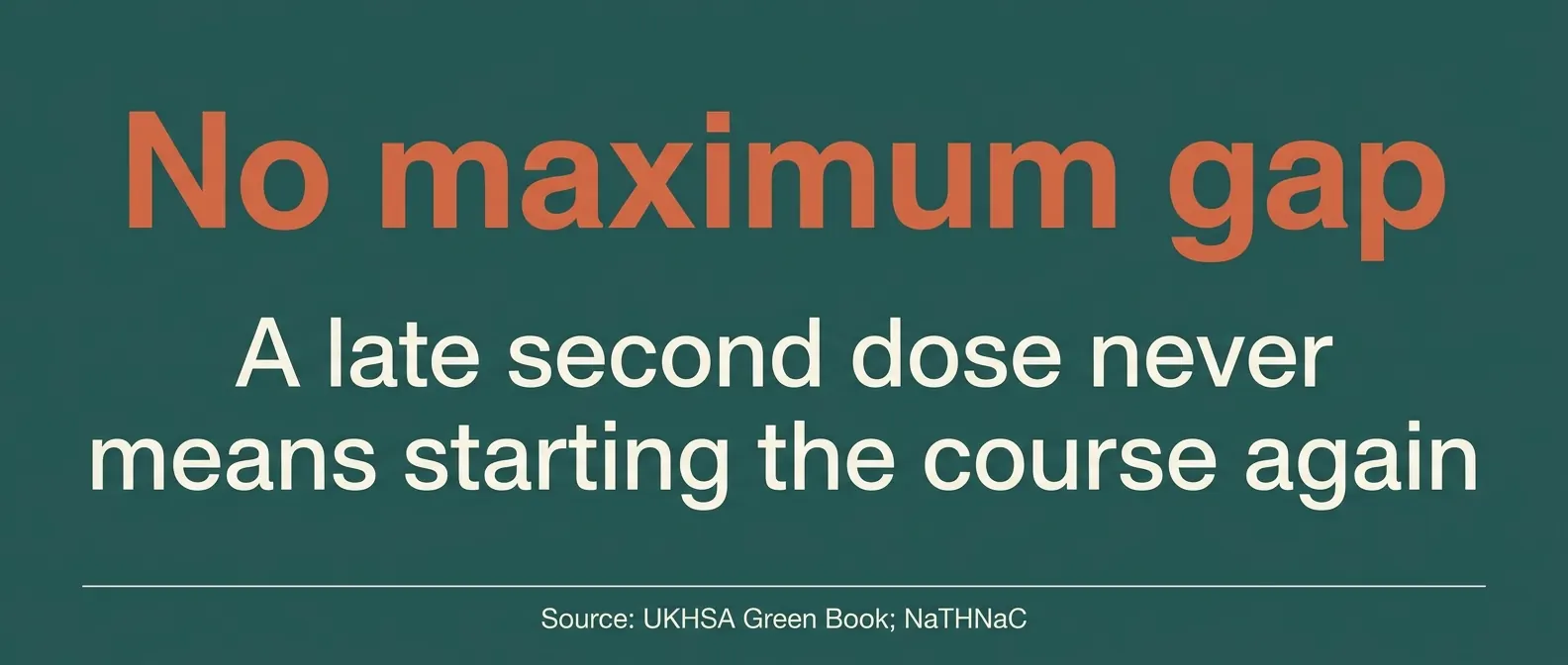
Studies show the second dose still gives a good boost even when it’s delayed for several years. There’s no maximum gap between the doses that would mean restarting the course.
First dose somewhere else
The single hepatitis A vaccines can be used interchangeably, so a first dose given at another clinic, or in another country, still counts. Bring any record you have and the pharmacist will work out where you stand.
A weakened immune system
People with a weakened immune system, including people with HIV, can have the vaccine, but their response may be weaker. UK guidance says another course should be considered, and specialist advice may be needed. Tell us about any condition or treatment when you book. Our guide to hepatitis A vaccine side effects covers who should talk to us first.
Children
The vaccine is recommended from one year old for children travelling to areas where hepatitis A is common. It isn’t licensed for babies under one.
Your second dose in Epsom
Had your first dose with us, or somewhere else? We’re at 94 Chessington Road, Ewell, Epsom, KT19 9UR, and there’s a car park at Ewell West station nearby. Whether you’re in Epsom itself or coming from Sutton, Cheam or Banstead, it’s one short appointment. Call us on 020 8393 1000 to book your second dose.
Questions about how long it lasts
Is the hepatitis A vaccine for life?
A full two-dose course gives at least 25 years of protection in adults, and the World Health Organization says it’s possibly lifelong.
My second dose is three years late. Do I start again?
No. There’s no maximum gap, so you carry on with the second dose. Bring your record and the pharmacist will pick up where you left off.
Do I need a booster before every trip?
A completed course lasts at least 25 years in adults. UK guidance keeps the booster at 25 years for people still at risk. If you’ve had one dose only, that dose covers up to 12 months, so check when yours was.
Can my second dose be a different make of vaccine?
Yes. The single hepatitis A vaccines can be used interchangeably.
I’m flying next week and haven’t had any doses. Is one enough?
One dose covers you for up to 12 months, and it can be given up to the day you travel. Our guide to having the hepatitis A vaccine at the last minute explains the timing.
Sources
- UKHSA: the Green Book, chapter 17, hepatitis A, checked 2 October 2026
- NaTHNaC: hepatitis A factsheet, checked 2 October 2026
- WHO: hepatitis A vaccines position paper, 2022 (summary), checked 2 October 2026