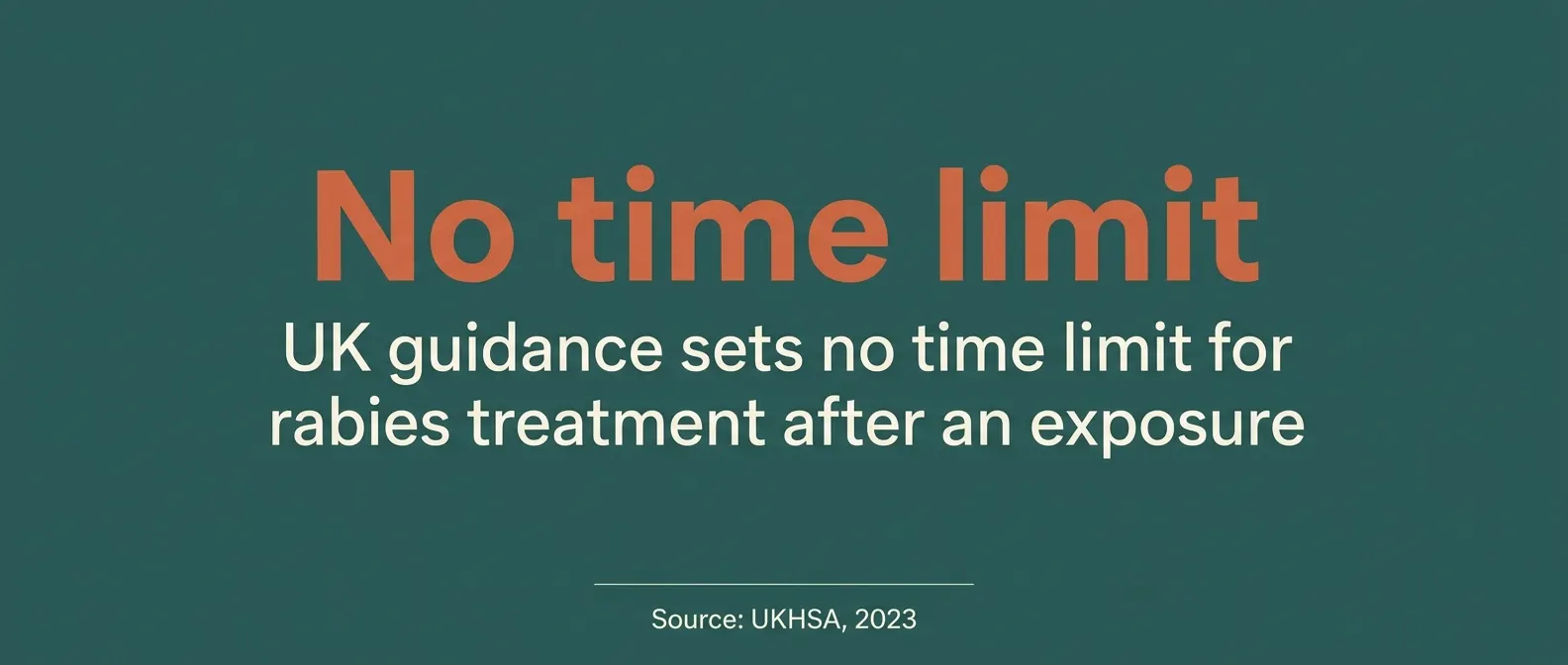
No. UK guidance says there’s no time limit for starting rabies treatment after a bite, scratch or lick, because rabies can take weeks, months or even years to develop. But don’t wait: get medical help as soon as you can, wherever you are. In the UK, treatment after an exposure is arranged through your GP or NHS 111 and given free. What we offer is the rabies vaccine in Epsom before you travel, which makes any treatment after a bite much simpler.
Why it’s never too late to ask
UKHSA’s treatment guidelines say: “Due to the potentially long incubation period for rabies there is no time limit for giving PET and all potential exposures should be risk assessed.” PET is post-exposure treatment, the vaccine (and sometimes an antibody injection) given after a possible exposure.
The reason is how slowly rabies can develop. Symptoms usually start 3 to 12 weeks after an exposure, but the Green Book records a range from four days to 19 years. It says a risk assessment should always be done, “even if the exposure occurred many months or years previously”. So whether it’s been 7 days, 7 weeks or longer, the answer is the same: get it checked.
Why sooner is still better
No time limit doesn’t mean there’s no hurry. Once symptoms appear, the NHS says rabies is almost always fatal, and treatment has to be in place before then. If treated quickly, the NHS says treatment is usually very effective at preventing rabies.
In the UK, UKHSA says starting treatment isn’t a medical emergency and can often wait until the next day. For high-risk exposures, such as severe or multiple bites to the head and neck, or a bite from an animal confirmed to have rabies, treatment must start as soon as possible, within 12 hours of reporting.
If it happens abroad
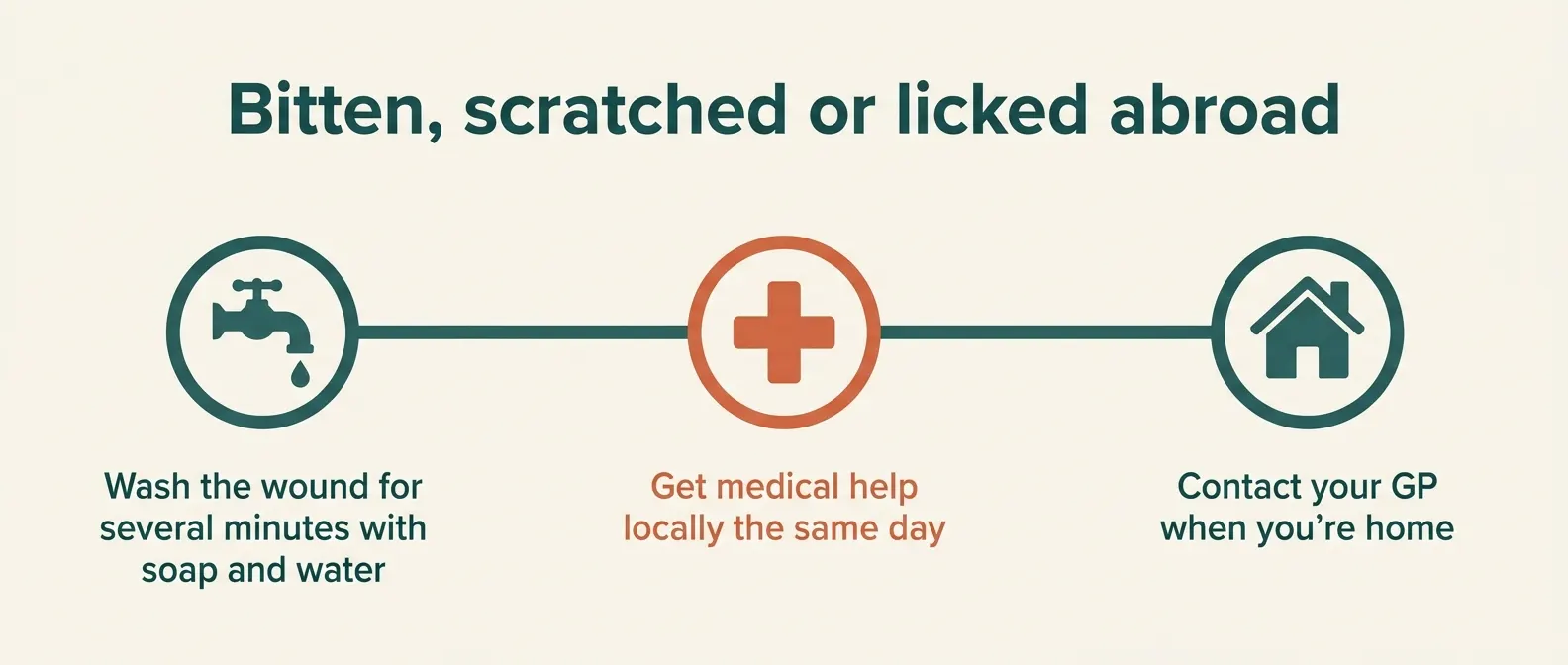
- Wash the wound straight away. The Green Book says to flush it under a running tap for several minutes and wash it with soap or detergent and water. The World Health Organization says to wash it with soap and water for at least 15 minutes. If saliva got into your eyes, nose or mouth, rinse them well with clean water.
- Get medical help locally, the same day. The NHS says: “Do not wait until you get back to the UK.”
- Keep a record of every dose you’re given: the date, the vaccine and how it was given. A UK clinician will use it to carry on your course.
- Contact your GP when you’re home. UKHSA says to do this even if you were treated abroad, or if the exposure was several weeks ago.
Treatment abroad can be harder to get than you’d expect. NaTHNaC quotes a study that found 204 of 240 countries had limited or no access to rabies immunoglobulin, the antibody injection given alongside the vaccine after higher-risk exposures.
If you’re already back in the UK
The NHS says to ask for an urgent GP appointment, call NHS 111 or use 111 online. Tell them where you were, what animal it was, what happened and when, and whether you’ve ever had the rabies vaccine. The doctor works out the risk with advice from UKHSA, looking at three things:
- the country, using UKHSA’s list of rabies risks by country;
- the kind of contact, from no contact with saliva, through minimal contact, to direct contact with saliva;
- the animal, and whether it’s known to have rabies.
Together these give a green, amber or red risk. Green means no treatment. Amber and red mean treatment, and the Green Book says the vaccine and immunoglobulin for treatment after an exposure are free from UKHSA.
What treatment involves
The treatment depends mostly on whether you’d had the rabies vaccine before the bite.
| Before the bite | Amber risk | Red risk |
|---|---|---|
| Never vaccinated | 4 doses of vaccine: days 0, 3, 7 and 21 | Immunoglobulin and 4 doses of vaccine: days 0, 3, 7 and 21 |
| Fewer than three doses | 4 doses of vaccine: days 0, 3, 7 and 21 | 4 doses of vaccine: days 0, 3, 7 and 21 |
| A full course (three doses or more) | 2 doses of vaccine: day 0 and day 3 to 7 | 2 doses of vaccine: day 0 and day 3 to 7 |
| A weakened immune system, vaccinated or not | Immunoglobulin and 5 doses of vaccine: days 0, 3, 7, 14 and 30 | Immunoglobulin and 5 doses of vaccine: days 0, 3, 7, 14 and 30 |
Where we come in
We don’t give treatment after a bite: that’s arranged through your GP or NHS 111. Where we help is before your next trip. A full course before you travel means that if it happens again, you’d usually need two doses of vaccine and no immunoglobulin, instead of four doses and a search for immunoglobulin. UKHSA says that’s true “even years beforehand”. Our guide to whether you can still get rabies if you’re vaccinated explains why, and our guide to how many doses of the rabies vaccine you need shows how to fit the course around your flight.
Before your next trip, in Epsom
We have the rabies vaccine in stock at our Epsom pharmacy (checked October 2026), at £80 a dose. We’re at 94 Chessington Road, Ewell, Epsom, KT19 9UR, with a bus stop outside on each side of the road and a car park at Ewell West station nearby. Whether you’re in Epsom or coming from Sutton, Cheam or Kingston, we’ll book your later doses before you leave your first appointment. Call us on 020 8393 1000.
Questions about late rabies treatment
Is 7 days too late for the rabies vaccine after a bite?
No. UK guidance has no time limit for treatment after an exposure. Get medical help as soon as you can.
It was months ago. Is it worth getting checked?
Yes. The Green Book says a risk assessment should always be done, even if the exposure was many months or years ago. Ask for an urgent GP appointment or call NHS 111.
Can I get rabies treatment at a pharmacy?
Start with your GP or NHS 111. The vaccine and immunoglobulin for treatment after an exposure come free from UKHSA, and UKHSA says immunoglobulin isn’t available through pharmacies.
A dog licked me on holiday. Does that count?
The NHS says to get medical help straight away if an animal abroad licked your eyes, nose or mouth, or licked a wound. If you’re not sure whether it counts, ask your GP or NHS 111.
I started treatment abroad. What now?
Contact your GP when you’re home and take the record of what you were given. UKHSA says most vaccines used around the world are compatible with the UK’s, so your course can usually carry on here.
What about a bat in the UK?
The NHS says to get medical help straight away if you’ve been bitten or scratched by a bat in the UK.
Sources
- UKHSA: guidelines on rabies post-exposure treatment (January 2023), checked 3 October 2026
- UKHSA: rabies, summary of risk assessment and treatment, checked 3 October 2026
- UKHSA: interim recommendations for rabies immunoglobulin use (30 June 2025), checked 3 October 2026
- UKHSA: the Green Book, chapter 27, rabies (May 2023), checked 3 October 2026
- UKHSA blog: how to avoid rabies and what to do if you’re exposed while travelling (18 June 2025), checked 3 October 2026
- UKHSA: Vaccine update, issue 361 (July 2025), checked 3 October 2026
- NHS: rabies, checked 3 October 2026
- NaTHNaC: rabies factsheet (20 June 2025), checked 3 October 2026
- WHO: rabies fact sheet (17 September 2026), checked 3 October 2026