Travel vaccination
Rabies Vaccine in Epsom
Rabies is almost always fatal once symptoms start, and almost entirely preventable if you get the right treatment quickly after a bite. That gap is what this page is about.
- Registered Yellow Fever Vaccination Centre
- GPhC premises 9011598
We have rabies vaccine today. Call and we'll hold the doses your course needs.
Recommendations depend on your itinerary, health history and current guidance.

NaTHNaC Registered Yellow Fever Vaccination Centre
A Yellow Fever Vaccination Centre on the NaTHNaC register, and the same travel clinic that gives your other vaccinations.
GPhC registered premises
9011598
Private and NHS pharmacy services from one registered pharmacy in Ewell, Epsom.
In short
Miles Pharmacy in Epsom gives rabies vaccination before travel. The standard course is three doses over three to four weeks, or one week on the accelerated schedule. It doesn't replace urgent treatment after a bite, but it makes that treatment simpler and usually avoids immunoglobulin, which is scarce abroad.
- If you're bitten
- Same day medical help where you are, vaccinated or not
- The course
- Three doses over three to four weeks, or one week if time is short
- What it changes
- Two, not four injections after a bite, and usually no immunoglobulin
- Price
- £80 a dose, course of 3
Bitten, scratched or licked by an animal abroad?
This comes first because it matters most, vaccinated or not.
Wash it straight away. Flush the wound under running water for several minutes, then wash it thoroughly with soap and water. If saliva got into your eyes, nose or mouth, rinse them with clean water.
Disinfect and cover. Apply a disinfectant such as 70% alcohol or iodine, and a loose, simple dressing. Stitches should wait until treatment has started.
Get medical help today, where you are. Even if the wound looks trivial, and even if you've had the vaccine. Don't wait until you're back in the UK. You may need to travel to a larger city for the right treatment.
Start treatment abroad if advised. Post-exposure treatment should start as soon as possible. If immunoglobulin isn't available, the vaccine should still be started.
Keep records. Photograph or write down every injection you're given, including the name and type of vaccine and any immunoglobulin. Some countries use vaccines that don't match UK ones, and you may need extra doses when you get home.
Other things they may give you. A tetanus booster if yours isn't up to date, and sometimes antibiotics to prevent the wound becoming infected.
When you're home. Contact your GP or call NHS 111, even if your treatment abroad seemed complete, and call your travel insurer.

Work it out
Your bite first-aid card
The steps to take if an animal bites, scratches or licks you, and space to note any treatment you're given abroad. Screenshot it before you fly.
This works out an answer in your browser. With JavaScript off, the sections below say the same thing in full.
Call us on 020 8393 1000First aid only. Always get medical help the same day, vaccinated or not.
What rabies is
-
How it spreads
Through the saliva of an infected mammal, usually by a bite or scratch, or when saliva touches broken skin or the eyes, nose or mouth. In up to 99% of human cases the animal is a dog, but cats, monkeys, bats and other mammals can all carry it.
-
Once symptoms start
It's almost always fatal. Only a handful of people are known to have survived, most with lasting brain damage.
-
How long it takes
Usually three to 12 weeks from exposure, but it can be as short as four days or, rarely, years. Bites to the face, head and hands can develop faster.
-
Why treatment works
There's no test to tell whether you're infected before symptoms appear, but prompt wound care, vaccination and, where needed, immunoglobulin prevent rabies in almost every case, even after high-risk exposures.
Your risk, honestly
- Rare disease, common bites
- Rabies in travellers is rare, but an estimated 0.4% of travellers have a potential rabies bite for every month they spend in a country where it's present.
- Where travellers get bitten
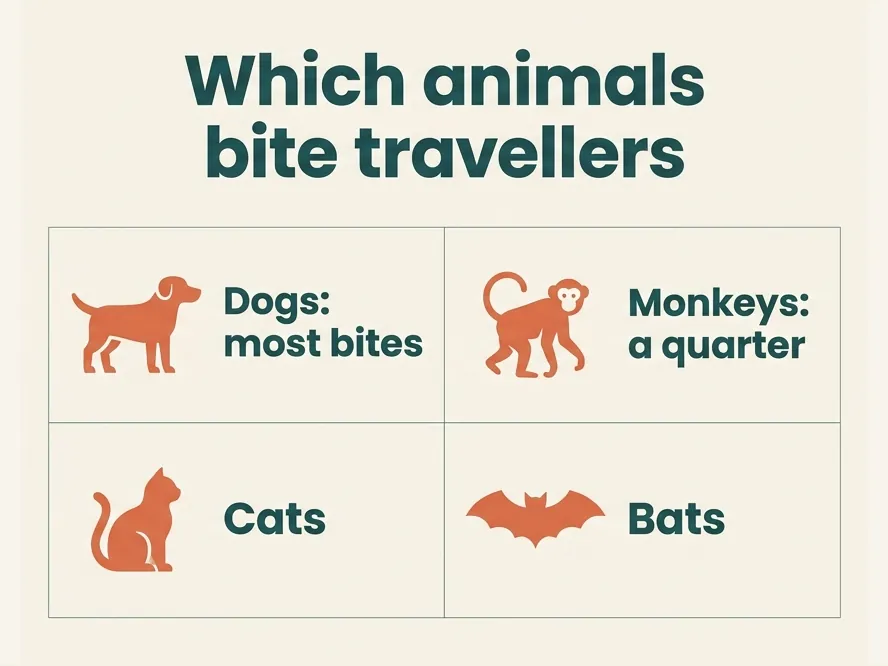
- In a large study of travellers needing treatment, 70% had been exposed in Asia, mostly South-East Asia. Dogs caused most exposures, monkeys about a quarter, followed by cats and bats. Monkey bites were even more common among tourists.
- UK deaths
- A UK traveller died in June 2025 after contact with a stray dog in Morocco, and another in 2018 after a cat bite, also in Morocco. Of 25 UK deaths from imported rabies between 1902 and 2005, 16 followed bites on the Indian subcontinent.
- Treatment isn't always easy to get
- Rabies vaccine and immunoglobulin can be expensive and hard to find, particularly outside major cities. One study found 204 of 240 countries and territories had limited or no access to immunoglobulin.
Where rabies is found
Rabies is present on every continent except Antarctica, but the risk varies enormously.
- Asia and Africa
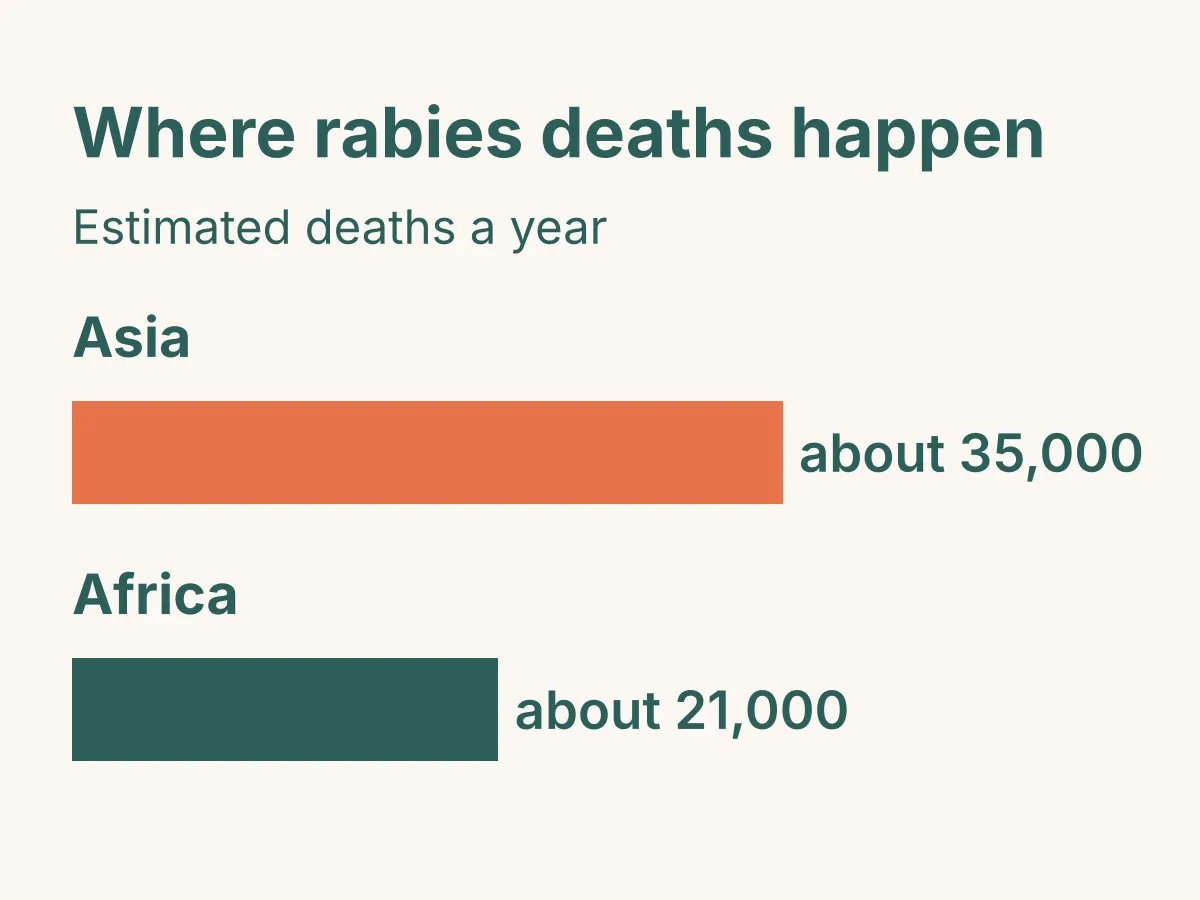
- More than 95% of human rabies cases are in Asia and Africa, mainly where dogs carry the virus. UK guidance estimates around 59,000 rabies deaths a year worldwide, about 35,000 of them in Asia and 21,000 in Africa, with India accounting for the most deaths of any country.
- Latin America
- Dog vaccination has cut human cases sharply, and bats now cause most human cases in the Americas.
- Europe, North America and Australia
- Western Europe, the USA, Canada and Japan have eliminated dog rabies, but wild animals and bats can still carry it. Illegally imported pets have brought rabies into Europe, including puppies taken to Germany and France.
- In the UK
- There's no rabies in UK land animals, but some UK bats carry a related virus that causes the same disease. A bat handler died of it in Scotland in 2002, and the virus was last found in a UK bat in 2025. Never handle bats without training.
- Our destination guides
- The guides below show how rabies risk compares between countries, with the higher-risk destinations first.
Who it is for
Who should have rabies vaccine before travel
- Limited access to treatment
- Anyone travelling somewhere they'd struggle to get rabies treatment quickly, such as rural or remote areas.
- Long stays
- Stays of more than a month in countries where rabies is present.
- Higher-risk activities
- Running, cycling and trekking, which attract dogs, and caving or anything that brings you near bats.
- Animal and health workers
- Vets, animal handlers, wildlife volunteers and health workers who may treat rabies patients abroad.
- Children
- Around 40% of people bitten by suspected rabid animals are under 15. Children are more likely to be bitten on the face or head, less likely to tell you about a scratch or lick, and can be vaccinated at any age.
- People at risk in the UK
- Bat handlers, including volunteers, laboratory staff working with the virus, quarantine workers and some veterinary staff. Your employer or organisation may arrange this.
Work it out
Should you have rabies vaccine for this trip?
Four questions about where you're going and what you'll be doing. Whatever it says, the first-aid steps above apply to everyone.
This works out an answer in your browser. With JavaScript off, the sections below say the same thing in full.
Call us on 020 8393 1000Your answer
- Things about a trip that raise the answer
- 5
- Of those, routes where somebody else pays
- 1
- Rules last checked
- 3 October 2026
This is a guide, not a clinical assessment. Whatever it says, if an animal bites, scratches or licks you abroad, get treatment the same day.
What the vaccine changes if you're bitten
This is the real reason to have it.
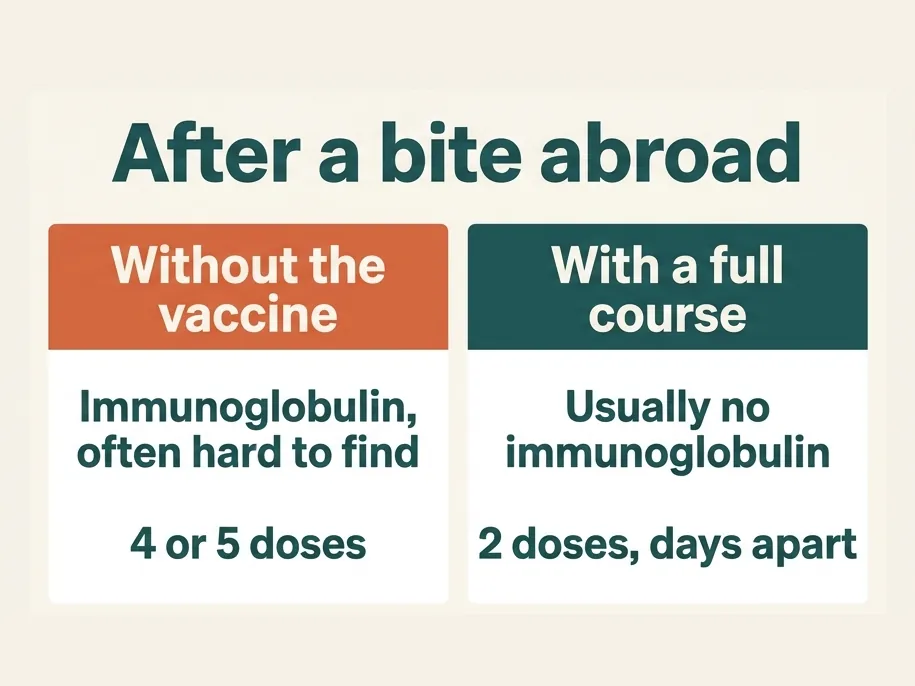
- Without pre-travel vaccine
- After a significant exposure you'd usually need a course of four or five vaccine injections over several weeks, and often rabies immunoglobulin as well, injected into and around the wound. Immunoglobulin is in short supply in much of the world, which can mean travelling to another city or country to find it.
- With a full course
- You'd usually need two booster injections a few days apart, and no immunoglobulin in most circumstances. That's far easier to arrange, faster, and cheaper.
- Either way
- You still need urgent medical help the same day. Carry your vaccination record so the doctor can see what you've had.
The course
Courses and timing
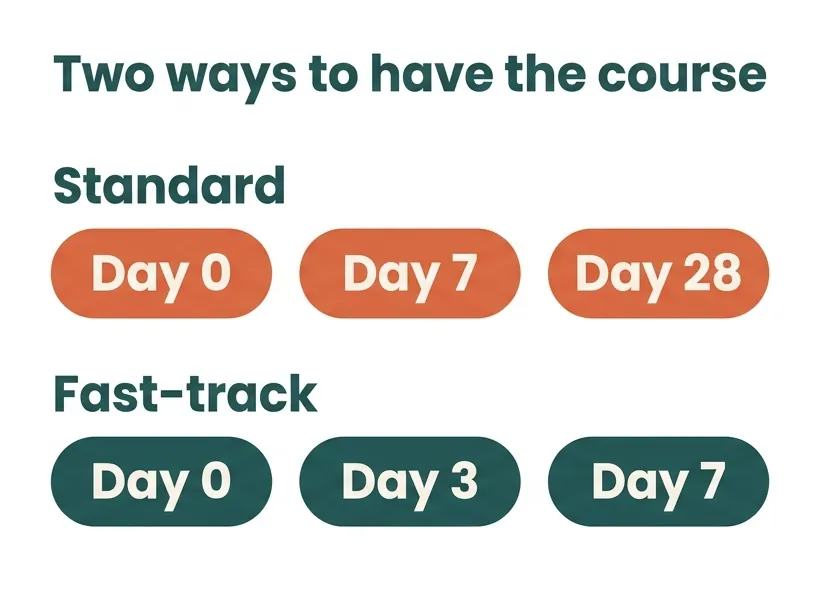
- Standard: days 0, 7 and 28
- Three doses. The third can be brought forward to day 21 if time is short. This is the preferred UK schedule when there's time.
- Accelerated (fast-track): days 0, 3 and 7
- Three doses in a week, for when you travel in under four weeks. If you'll be at risk again in future, a fourth dose a year later completes the course.
- Two doses a week apart
- Licensed for both UK vaccines, but UK guidance on it is still awaited and it currently counts as partial protection here. So we give the three-dose courses.
- Interrupted course
- If a dose is delayed, carry on where you left off. Rabies courses are never restarted.
- Finishing abroad
- If stock or time means you can't finish before you go, the course can sometimes be completed at a travel clinic abroad. Take your record with you.
What it costs
Price
| Vaccine | What that covers | Price |
|---|---|---|
| Rabies (pre-exposure) | 3 doses, £80 each | £240 |
| One-year dose after an accelerated course (if you need it) | Single dose | £80 |
One price, paid when you book.
Work it out
When do I need to start?
Enter your travel date and this shows which course still fits.
This works out an answer in your browser. With JavaScript off, the sections below say the same thing in full.
Call us on 020 8393 1000Your answer
- I know when I'm flying
- Which courses still finish in time, fastest first, and the date each one completes
- My course was interrupted
- The doses left and when, without restarting
- I know which course
- Every dose date and the date the course completes
Dates show timing only. Stock and suitability are confirmed at your appointment.
Do you need a booster?
-
Most travellers
No routine boosters. If your course finished more than a year ago and you're heading back to a high-risk area, a single booster can be considered.
-
Frequent animal or bat contact
A booster a year after the course and another at three to five years, or timed by a blood test.
-
Laboratory staff
A booster at one year and blood tests every six months.
-
Blood tests for travellers
Not routinely needed. Some people choose one, but there are no specific UK guidelines on interpreting the result for travellers.
Avoiding bites and scratches
- Don't touch
- Don't approach, feed or stroke dogs, cats, monkeys or other animals, however friendly or tame they seem. An animal behaving normally can still be infectious.
- Monkeys
- Keep food and shiny objects out of sight around temples and viewpoints, and don't feed or photograph them up close.
- Dogs
- Running and cycling attract them. Slow down, don't run away, and keep something between you and the dog.
- Bats
- Never handle one. A bat found in the room of someone who was asleep, or a child who can't say what happened, counts as a possible exposure.
- Children
- Supervise them around animals, and make sure they know to tell you straight away about any bite, scratch or lick, even a small one.
Vaccine supply
The position. Supply of both rabies vaccines used in the UK was limited earlier in 2026. We have the rabies vaccine in stock at our Epsom pharmacy (checked October 2026).
If stock is short. We'll prioritise the course you need most, and if a dose is delayed you simply carry on later. Nobody needs to restart.
Whatever happens. The first-aid steps and same-day treatment advice apply to everyone, vaccinated or not.
Safety
Safety and side effects
- It isn't live
- An inactivated vaccine, so it can't cause rabies.
- Common side effects
- Itching, soreness or redness where the injection went in, sometimes with a mild fever, headache, dizziness or feeling unwell. These usually pass quickly.
- Who can't have it
- Anyone who's had a severe allergic reaction to a previous dose or ingredient. One of the UK vaccines contains traces of chicken protein, so people with severe egg allergy are given the other.
- Pregnancy
- It can be given when the risk justifies it, and we'll talk it through with you.
- Weakened immune system
- The response may be weaker, and if you're bitten you'll need a longer treatment course and a blood test. We'll plan with you.
Your appointment
What the appointment involves
-
Bring
Your travel dates and itinerary, any vaccination records, and a list of medicines. If you take chloroquine for malaria, mention it.
-
Booking the course
We book every dose before you leave, so the course finishes in time. We can give your other travel vaccines at the same visit, such as the Japanese encephalitis jab for rural trips in Asia.
-
Your record
You leave with a written record of every dose. Keep it with your passport: it's what a doctor abroad needs to see if you're bitten.
Before you book
Questions about the rabies (pre-exposure) vaccine
Answered by the pharmacist who signs this page off.
-
£80 per dose, £240 for the three-dose course. If you need the one-year dose after an accelerated course, that's another £80.
-
Yes, always, and the same day. The vaccine means you'll usually need two injections instead of four or five, and usually no immunoglobulin, but you still need them.
-
Not necessarily. The accelerated course is three doses over seven days. If there isn't time for that, call us: part of a course can sometimes be finished abroad, and the first-aid advice still protects you.
-
It depends on the trip. Long stays, remote travel, running or cycling, animal contact and travelling with children all point towards it. India has the highest rabies burden in the world, and South-East Asia is where most travellers get bitten.
-
It's a blood product given into and around a wound to protect you while the vaccine starts working. It's in short supply in most countries. A full pre-travel course usually means you won't need it.
-
Yes. Monkeys cause about a quarter of exposures in travellers. Wash the scratch thoroughly and get medical help the same day.
-
Yes, at any age. Children are at higher risk because they're more likely to be bitten on the face and less likely to mention a scratch or lick.
-
Most travellers don't. If your course finished over a year ago and you're returning to a high-risk area, a single booster can be considered.
-
No. Carry on where you left off. Rabies courses are never restarted.
-
Not in land animals, but some UK bats carry a related virus. If a bat bites or scratches you, wash the wound and call NHS 111 the same day. Never handle bats unless you're trained and vaccinated.
-
Supply of both UK rabies vaccines was limited earlier in 2026. We have it in stock at our Epsom pharmacy (checked October 2026), so you can start a full course now.
-
At Miles Pharmacy, 94 Chessington Road, Ewell, Epsom, KT19 9UR. There's a bus stop outside on each side of the road, and Ewell West station, step-free to every platform, is nearby with a car park. Patients come to us from across Surrey, including Ewell, Ashtead, Leatherhead and Banstead, and from Sutton, Cheam, Surbiton and Kingston in south-west London.
-
Not for travel: the NHS says you usually have to pay for the rabies vaccine before a trip. Treatment after a bite is different. It's arranged through your GP or NHS 111 and is free.
-
Yes. The accelerated course gives all three doses in a week, on days 0, 3 and 7, for when you fly in under four weeks. If you'll be at risk again in future, a fourth dose a year later completes it.

Guides and advice
Guides on rabies (pre-exposure)
-
 Rabies
How many doses of the rabies vaccine do you need?
-
 Rabies
Is 7 days too late for the rabies vaccine after a bite?
-
 Rabies
Can you still get rabies if you’re vaccinated?
Guides are a starting point, not a diagnosis. What is right for you depends on your health history, your medicines and what a pharmacist finds on the day.
Find the pharmacy
Where to come, and when
Miles Pharmacy is in Epsom, Surrey. Patients come to us from across Surrey, including Ewell, Ashtead, Leatherhead and Banstead, and from Sutton, Cheam, Surbiton and Kingston in south-west London.

Ewell, Epsom, Surrey KT19 9UR
How to get here Parking, trains, buses and step-free access
-
The door is on Chessington Road, with step-free access
-
The station car park, on Station Approach off Chessington Road
- Address Elizabeth Court, Station Approach, KT17 1DR
-
Step-free to all platforms, by a footbridge with lifts
- Step-free to every platform (National Rail step-free category A)
- Lifts two, on the footbridge
Checked against nationalrail.co.uk
-
Outside the pharmacy, with a stop on each side of Chessington Road
-
Cycle parking at the station
Take this with you
Point your phone's camera at the code and this page opens there, with the directions one tap away.
Sources
- NaTHNaC: rabies factsheet, dated . Checked .
- UKHSA Green Book chapter 27: rabies, dated . Checked .
- NaTHNaC: rabies vaccine shortage, advice for health professionals, dated . Checked .
- UKHSA: rabies case confirmed following contact with animal abroad, dated . Checked .
- UKHSA: rabies post-exposure treatment management guidelines. Checked .
- WHO: rabies fact sheet. Checked .
- NHS: rabies. Checked .
Travel health
Book before you pack.
Choose a service and a date that suits you. One of us confirms it with you directly.
- Private and NHS
- GPhC premises 9011598
- Open until 6:30pm
Prefer to talk? 020 8393 1000