Travel vaccination
Yellow Fever Vaccine and Certificate in Epsom
Yellow fever vaccination does two jobs. It protects you against a disease that turns severe in a small number of people and kills a high proportion of those it does, and it produces the certificate some countries demand at the border.
- Registered Yellow Fever Vaccination Centre
- GPhC premises 9011598
Recommendations depend on your itinerary, health history and current guidance.

NaTHNaC Registered Yellow Fever Vaccination Centre
We hold the vaccine on site and issue your International Certificate of Vaccination at your appointment.
GPhC registered premises
9011598
Private and NHS pharmacy services from one registered pharmacy in Ewell, Epsom.
In short
You can get the yellow fever vaccine and the official certificate at Miles Pharmacy in Epsom, a NaTHNaC registered Yellow Fever Vaccination Centre. One dose protects most people for life. The certificate is issued on the day and becomes valid 10 days later, so book at least 10 days before you fly.
- Doses
- One protects most people for life
- Certificate valid from
- 10 days after your appointment
- Where
- Ewell, Epsom Miles Pharmacy, a NaTHNaC registered Yellow Fever Vaccination Centre
- Price
- £80 one dose, certificate included
The certificate
The certificate, and why the rules differ by country
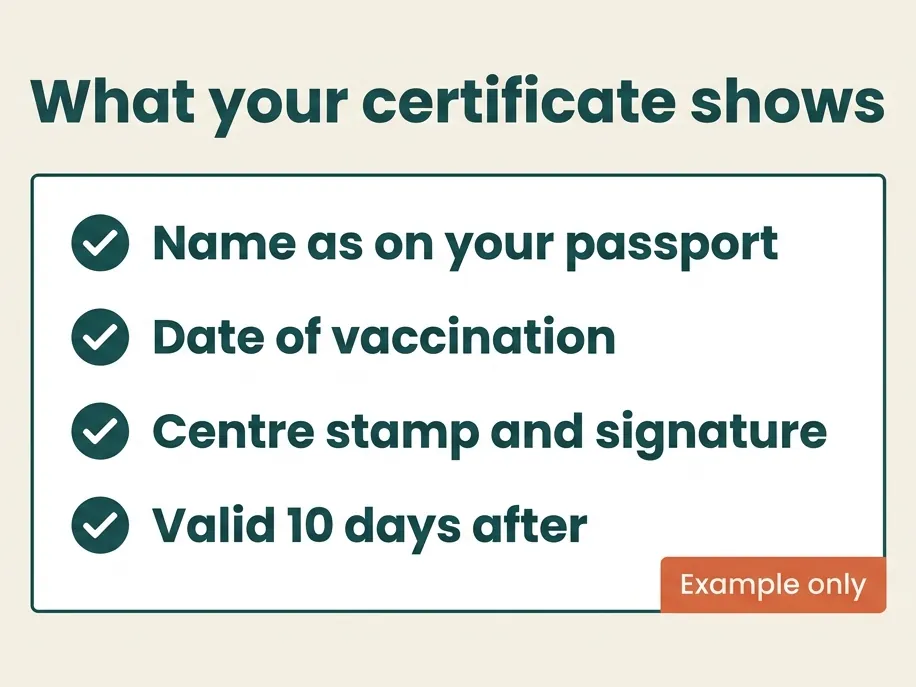
- What you get
- An International Certificate of Vaccination or Prophylaxis, the ICVP, stamped and signed by the centre. Keep it with your passport and take it with you, since a photo on your phone may not be accepted.
- Name and passport details
- The name on the certificate has to match your passport. Bring your passport to the appointment so we get it right the first time.
- Transit rules vary
- Some countries count a long airport transit through a risk country, some ignore transit entirely as long as you stay airside, and some count anyone arriving within six days of leaving a risk country. There's no single rule to rely on, so check the country pages for your exact route before you book flights.
- If you can't have the vaccine
- Where vaccination is contraindicated and a certificate is required, a medical letter of exemption can be issued at the pharmacist's discretion after an assessment. Border officials aren't obliged to accept one, so it's a decision made case by case, and it's worth planning your route with that in mind.
By region
Where yellow fever is found
These are the countries NaTHNaC lists as having a risk of yellow fever transmission, the same list the route checker works from. The vaccine is recommended for travel to any of them unless there's a medical reason not to have it, and we check the current guidance for your route at the appointment.
Source: NaTHNaC: countries with risk of yellow fever transmission, checked 17 September 2026.
-
29 countries
Africa
Angola, Benin, Burkina Faso, Burundi, Cameroon, Central African Republic, Chad, Congo, Cote d'Ivoire, Democratic Republic of the Congo, Equatorial Guinea, Ethiopia, Gabon, Gambia, Ghana, Guinea, Guinea-Bissau, Kenya, Liberia, Mali, Mauritania, Niger, Nigeria, Senegal, Sierra Leone, South Sudan, Sudan, Togo, Uganda
Book a yellow fever appointment -
13 countries and territories
South and Central America
Argentina, Bolivia, Brazil, Colombia, Ecuador, French Guiana, Guyana, Panama, Paraguay, Peru, Suriname, Trinidad and Tobago, Venezuela
Book a yellow fever appointment - Not on the list? Do I need a yellow fever certificate? Check my route
Your appointment
What the appointment involves

- Bring
- Your passport, any vaccination records you have, a list of your medications and details of your itinerary, including stopovers.
- The assessment
- We work through the NaTHNaC pre-vaccination checklist every time. If the vaccine isn't suitable, we'll say so, explain why, and talk through the options including an exemption letter.
- Stock
- Yellow fever vaccine supply has been disrupted nationally in the past. Stock recovered from August 2025, but it's worth calling to confirm availability when you book, particularly at short notice.
Work it out
Do I need a yellow fever certificate?
Three questions about your route. It takes about twenty seconds, and it won't tell you that you're in the clear when we can't be sure.
This works out an answer in your browser. With JavaScript off, the sections below say the same thing in full.
Call us on 020 8393 1000Your answer
Answer the three questions and your result appears here.
This checker is a guide, not a border decision. Entry rules change and we can't see your full itinerary, so we confirm everything at your appointment.
Who it is for
Who needs the yellow fever vaccine
Two separate questions decide this, and they have different answers. Is there yellow fever where you're going, and does any country on your route want to see a certificate?
-
Travel to a risk area
Yellow fever is a risk in 29 countries in Africa and 13 countries and territories in South and Central America, plus Trinidad in the Caribbean. Vaccination is recommended from 9 months of age for travel to those areas, unless there's a medical reason not to. The same trips can call for malaria tablets, and vaccines against typhoid, hepatitis A and rabies, depending on where you're going.
-
Certificate requirements
Plenty of countries with no yellow fever at all still ask for a certificate if you're arriving from, or have passed through, a risk country. Thailand, India, Pakistan, Sri Lanka and Costa Rica all do, with different rules on transit and timing. For Hajj and Umrah, Saudi Arabia also asks every pilgrim aged 1 or over for the meningitis ACWY vaccine.
-
Multi-country trips
This catches people out most often. A single UK to Kenya flight is one thing, but South America overland, an African safari with a Nairobi stopover, or a cruise calling at several ports can trigger a requirement you didn't expect.
-
Work and volunteering
Laboratory staff working with the virus, aid and healthcare workers, and anyone posted to a risk area for an extended period.
-
Personal protection even where no certificate is required
A country can have yellow fever risk without demanding a certificate. In that case vaccination is still recommended for your own protection, and that's a judgement we make together at the appointment.
-
Work it out for your trip
Do I need a yellow fever certificate?
How it works
One dose, ten days, then a certificate for life
-
Day 0
Your appointment
One injection, and the certificate is issued on the day.
-
Days 1 to 9
Not valid yet
It does not satisfy a border requirement yet.
-
Day 10
The certificate counts
Valid from here, 10 days after vaccination.
-
For life
No expiry, no booster
Since 11 July 2016 it lasts the lifetime of the person vaccinated.

- The dose
- A single injection just under the skin. There's one yellow fever vaccine licensed in the UK.
- When it counts
- The certificate becomes valid 10 days after vaccination. Before that it doesn't satisfy a border requirement, so a last-minute appointment may not solve the problem.
- How long it lasts
- A single dose protects most people for life. Since 11 July 2016, WHO rules mean a valid certificate lasts the lifetime of the person vaccinated, and no country can turn it down for being more than ten years old or insist on a booster.
- When a booster is considered
- A small group may be offered a second dose, including people vaccinated while pregnant or immunosuppressed, those who had a suboptimal first dose, and infants vaccinated before 9 months of age. The pharmacist assesses that individually.
- Timing with other vaccines
- Yellow fever and MMR are both live vaccines and are best given either on the same day or at least four weeks apart. Worth mentioning when you book if you need both.
What it costs
Price
| Vaccine | What that covers | Price |
|---|---|---|
| Yellow fever | Single dose, certificate included | £80 |
One price, paid when you book.
Work it out
When do I need my appointment?
The certificate is valid 10 days after vaccination. Put in your travel date and this gives you the latest appointment that still works.
This works out an answer in your browser. With JavaScript off, the sections below say the same thing in full.
Call us on 020 8393 1000Your answer
Put in a date and your dates appear here.
- I know when I'm flying
- Latest appointment date, plus a recommended date four to six weeks out
- I've already been vaccinated
- The date from which the certificate is valid
Dates are based on the 10-day rule for certificate validity. Other vaccines on your trip may need longer, which we'll cover at your appointment.
Short notice
Flying in less than ten days?
This is the situation we get called about most, so here's the honest version.
Call us on 020 8393 1000You can still be vaccinated. Protection develops regardless, and if your trip is about personal safety rather than a border rule, a late appointment is still worth having.
The certificate won't be valid in time. It's valid from 10 days after vaccination, and that's set internationally. Nobody can bring it forward, and a certificate dated inside that window doesn't satisfy a border requirement.
What that means in practice. If a country on your route requires a certificate, you may need to change your routing, delay travel, or skip the leg that triggers the rule. We'll talk through what your options actually are.
Exemption letters aren't a shortcut. They exist for people who can't have the vaccine for medical reasons, not for people who left it late. Border officials aren't obliged to accept one.
Where the risk is
Where yellow fever is right now
- South and Central America
- 79 confirmed cases have been reported from six countries so far in 2026: Bolivia, Brazil, Colombia, Ecuador, Peru and Venezuela. That follows a sharp 2025, with 346 confirmed cases and 143 deaths across seven countries, more than five times the 2024 figure.
- Beyond the Amazon
- Cases used to cluster in the Amazon. Recent ones have appeared well outside it, including São Paulo State in Brazil and Tolima in Colombia, and transmission closer to cities raises the risk of urban outbreaks.
- Africa
- 16 confirmed cases have been reported in 2026 from Burkina Faso, the Central African Republic and Cameroon, with suspected cases in Angola, Côte d'Ivoire, Gabon, Ghana and Nigeria. Since 2023, eight countries with no recent history of yellow fever have detected cases.
- What that means for you
- Risk areas can shift, and surveillance is patchy in some countries, so the picture is likely to understate the true spread. We check the current country guidance at your appointment rather than working from a map printed last year.
Safety
Who can't have it, and who needs a closer look
Yellow fever vaccine is a live vaccine. For most people the balance of benefit and risk is clearly favourable, but the screening matters, and it's the reason every appointment starts with a checklist rather than a needle.
- Not suitable
- Infants under 6 months. Anyone who has had a severe allergic reaction to a previous dose or to a vaccine component, including egg protein and gelatin. Anyone with severe immunodeficiency, including symptomatic HIV, a CD4 count below 200, treatment that suppresses the immune system, or a thymus disorder or thymectomy.
- Needs individual assessment
- Infants aged 6 to 8 months. Adults aged 60 and over having a first dose. Pregnancy and breastfeeding. HIV with a CD4 count above 200 and suppressed viral load. Low-dose steroids or non-biological immunomodulatory drugs. Egg allergy, where most people can still be vaccinated after a detailed history. A first-degree family history of a serious reaction to the vaccine.
- Rare serious reactions
- Two rare conditions, YEL-AVD and YEL-AND, can follow a first dose, typically within 5 to 11 days. They're rare, and the risk rises with age and with thymus problems, which is why the screening questions are what they are.
- Usual side effects
- A sore arm, mild fever, headache and aching muscles for a few days are the common ones, and they settle by themselves.
Before you book
Questions about the yellow fever vaccine
Answered by the pharmacist who signs this page off.
-
At least 10 days, because that's when the certificate becomes valid. Ideally four to six weeks, which gives room for other vaccines you may need on the same trip.
-
Almost certainly not. Since July 2016 a valid certificate lasts for life, and no country can reject it for being over ten years old. A small group may still be offered a second dose, for example people vaccinated while pregnant or immunosuppressed, or infants vaccinated before 9 months.
-
It depends on where you're going and where you're arriving from. Check the destination pages for your route, or call us with your itinerary including stopovers, and we'll tell you before you book an appointment.
-
Often yes, but a first dose over 60 carries a slightly higher risk of rare serious reactions, so it needs an individual assessment. If you've had a dose before, that concern doesn't apply in the same way.
-
It's generally avoided, and given only if the risk of yellow fever is unavoidable and high. That's a conversation to have with us before you commit to the trip, not at the airport.
-
A medical letter of exemption can be issued after assessment where vaccination is contraindicated. Border officials aren't obliged to accept one, so it's worth planning your route with that in mind.
-
Only NaTHNaC registered Yellow Fever Vaccination Centres can give the vaccine or issue the certificate, and the staff giving it have to complete NaTHNaC's training programme. We're a registered centre, which is why we can, and why people come to our travel clinic in Surrey from across the county.
-
£80 for the single dose, with the certificate included. There's no separate consultation fee.

Guides and advice
Guides on yellow fever
-
 Yellow fever
Why is the Yellow Fever Vaccine Not Recommended for Over 60s?
-
 Yellow fever
Cause of Yellow Fever and Possible Vaccine Reactions
-
 Yellow fever
What to Expect from a Yellow Fever Vaccine?
Guides are a starting point, not a diagnosis. What is right for you depends on your health history, your medicines and what a pharmacist finds on the day.
Find the pharmacy
Where to come, and when
Miles Pharmacy is in Epsom, Surrey. Patients come to us from across Surrey, including Ewell, Ashtead, Leatherhead and Banstead, and from Sutton, Cheam, Surbiton and Kingston in south-west London.

Ewell, Epsom, Surrey KT19 9UR
How to get here Parking, trains, buses and step-free access
-
The door is on Chessington Road, with step-free access
-
The station car park, on Station Approach off Chessington Road
- Address Elizabeth Court, Station Approach, KT17 1DR
-
Step-free to all platforms, by a footbridge with lifts
- Step-free to every platform (National Rail step-free category A)
- Lifts two, on the footbridge
Checked against nationalrail.co.uk
-
Outside the pharmacy, with a stop on each side of Chessington Road
-
Cycle parking at the station
Take this with you
Point your phone's camera at the code and this page opens there, with the directions one tap away.
Sources
- NaTHNaC TravelHealthPro: Yellow fever update, dated . Checked .
- NaTHNaC Yellow Fever Zone (YFVC standards, ICVP, exemption letters). Checked .
- UKHSA Green Book chapter 35 and MHRA Drug Safety Update. Checked .
Travel health
Book before you pack.
Choose a service and a date that suits you. One of us confirms it with you directly.
- Private and NHS
- GPhC premises 9011598
- Open until 6:30pm
Prefer to talk? 020 8393 1000