Travel vaccination
Japanese Encephalitis Vaccine in Epsom
Japanese encephalitis is a virus carried by mosquitoes across much of Asia and the Western Pacific. Most people who catch it never know. In the rare cases where it reaches the brain, it's serious: a large share die, and many survivors live with lasting damage.
- Registered Yellow Fever Vaccination Centre
- GPhC premises 9011598
We have Japanese encephalitis vaccine in stock now (checked 6 October 2026).
Recommendations depend on your itinerary, health history and current guidance.

NaTHNaC Registered Yellow Fever Vaccination Centre
A Yellow Fever Vaccination Centre on the NaTHNaC register, and the same travel clinic that gives your other vaccinations.
GPhC registered premises
9011598
Private and NHS pharmacy services from one registered pharmacy in Ewell, Epsom.
In short
Miles Pharmacy in Epsom offers Japanese encephalitis vaccination. Protection starts a week after the second dose. Adults aged 18 to 65 can have both doses a week apart. Supply has been short nationally, but we have the vaccine in stock now.
- The course
- Two doses 28 days apart on the standard schedule
- Protection starts
- A week later after the second dose, never after the first
- Price
- £100 a dose, course of 2
What Japanese encephalitis is
-
How it spreads
Through the bite of Culex mosquitoes, which pick the virus up from pigs and wading birds. They feed mostly between dusk and dawn, and they thrive where there are rice fields and pig farms, though they're also found on the edges of towns.
-
Most infections are silent
Fewer than one in a hundred people infected develop symptoms. When they do, it starts like flu, with fever, headache and sometimes vomiting.
-
When it's serious
In the small number who develop encephalitis, inflammation of the brain, somewhere between 20 and 30 in every hundred die, and 30 to 50 in every hundred survivors are left with lasting problems with thinking, behaviour or movement.
-
No cure
There's no specific treatment for the virus, only supportive care. That's why prevention matters.
-
Work it out for your trip
Is the vaccine worth it for your trip?
Work it out
Is the vaccine worth it for your trip?
Four questions about your trip. It'll tell you honestly when the risk looks low for what you've described, and it ends at a conversation rather than a verdict: a form hasn't seen your itinerary.
This works out an answer in your browser. With JavaScript off, the sections below say the same thing in full.
Call us on 020 8393 1000Your answer
- Things about a trip that raise the answer
- 6
- Of those, routes where somebody else pays
- 1
- Rules last checked
- 17 September 2026
This is a guide, not a clinical assessment. We confirm at your consultation, and stock is confirmed there too.
Your risk, honestly
This is a rare infection in travellers, and we'd rather be straight with you about that. At your appointment we'll look at your itinerary with you and talk through whether it's worth it for your trip.
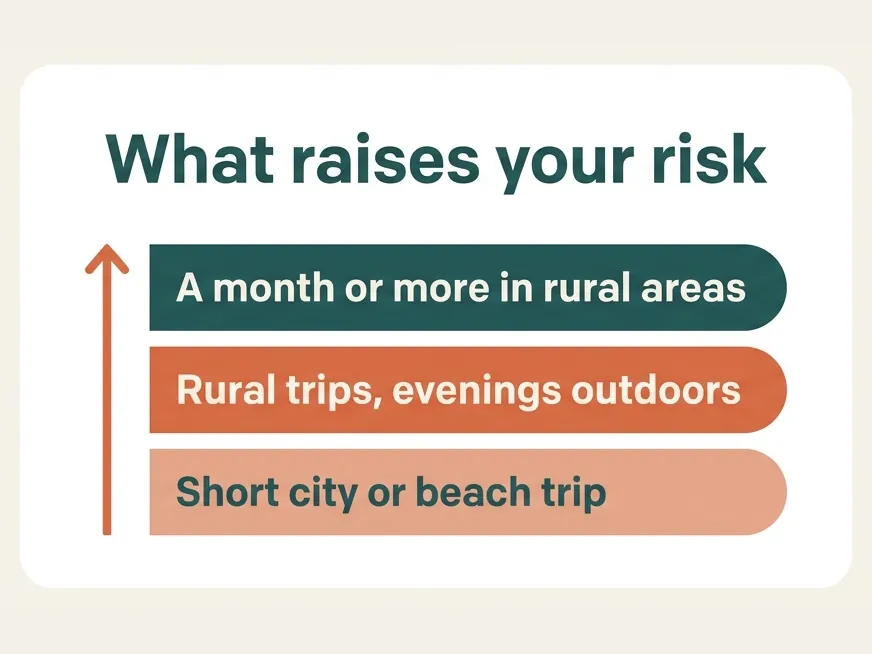
- For most trips, very low
- The overall risk for people travelling to Asia is estimated at less than one case per million travellers. Short trips to cities and beach resorts sit at the bottom of that range.
- What raises it
- Staying a month or more in a risk area, travelling in the transmission season, spending time in rural areas, and being outdoors around dusk or overnight. Any of these can matter even on a short trip, for example camping, cycling, fieldwork or visiting family in a farming area.
- Seasons
- In the temperate parts of Asia, transmission usually runs from about April or May to September or October. In the tropics it can happen all year, often peaking in the rainy season.
- Why people still choose it
- Because the illness is so serious when it does happen, and the vaccine is safe and effective, many people at increased risk decide the protection is worth it.
Who it is for
Who the vaccine is recommended for
-
Longer stays
A month or more in a risk area during the transmission season.
-
Frequent travellers
People who go back to risk areas regularly, including those visiting family.
-
Rural and outdoor trips
Shorter trips with significant rural, outdoor or night-time exposure: trekking, cycling, camping, rice fields, farms or fieldwork. On a rural trip in South-East Asia, ask about rabies vaccination too, as rabies treatment can be hard to find outside major cities. The same trips can call for vaccines against typhoid and hepatitis A, depending on where you're going.
-
Uncertain plans
Travellers whose itinerary might take them into rural areas but isn't fixed yet.
-
Outbreak areas
Anywhere with a current outbreak.
-
People living there
Expatriates and long-term residents, who need a booster a year after the first course.
-
Laboratory staff
Anyone working with the virus, through their employer.
-
Usually not needed
Short trips to cities and beach resorts with no rural time. We'll tell you if that's your trip.
Where Japanese encephalitis occurs
It's found across much of Asia and the Western Pacific, mainly in rural and farming areas. The risk varies within countries, so the detail of your itinerary matters more than the country name.
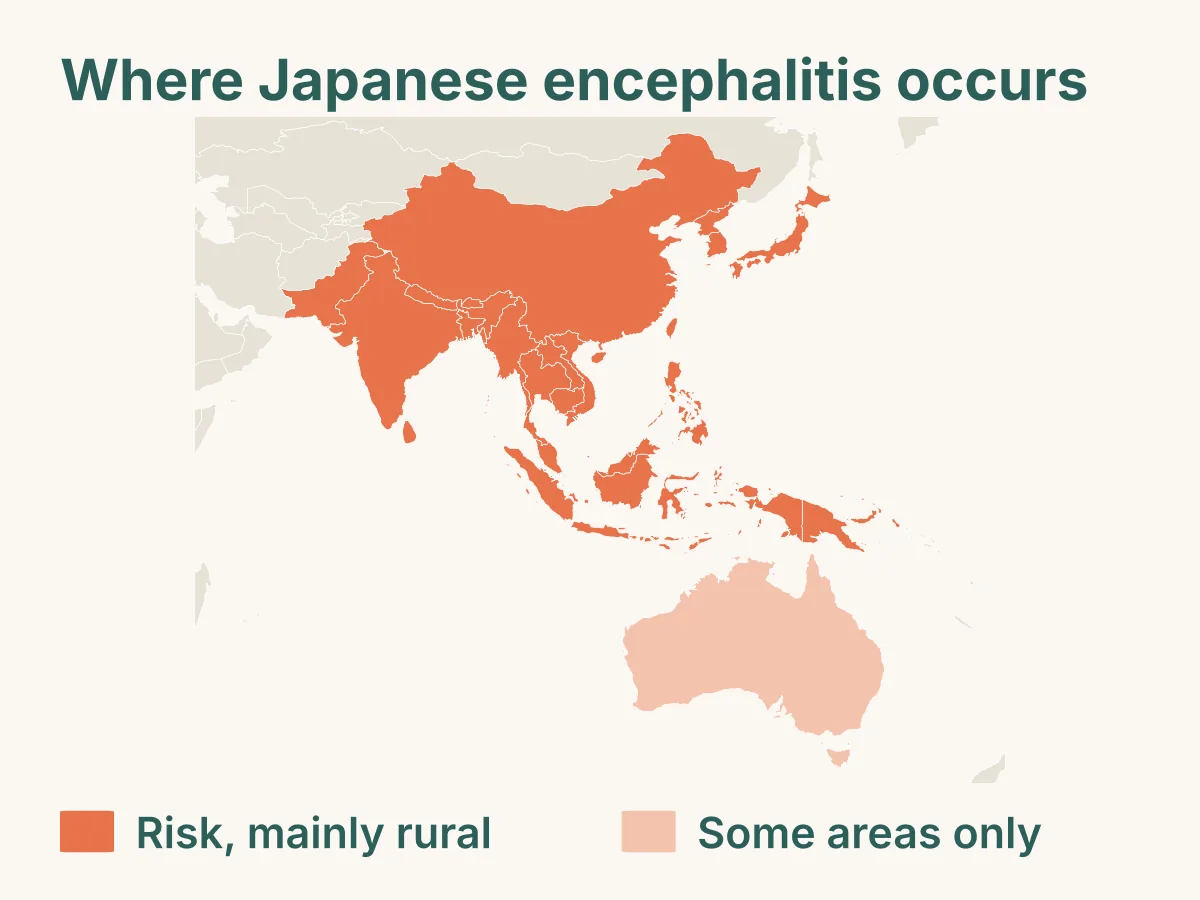
- Our destination guides
- Thailand, Vietnam, India, Sri Lanka and Pakistan all list the vaccine for some travellers. Each guide explains the seasons and the parts of the country where risk is highest.
- Recent reports
- Taiwan has reported ten confirmed cases in 2026, including one death, most in Taoyuan City. In Australia, the virus has been circulating in parts of New South Wales, with a probable case exposed in the Riverina in December 2025.
- Check your destination
- For anywhere we don't have a guide for, the TravelHealthPro country page is the most reliable UK source, and we'll check it with you at your appointment.
Stock: we have it now
The position. There's one Japanese encephalitis vaccine licensed in the UK, and it was out of stock nationally over the summer. Miles Pharmacy has stock now (checked 6 October 2026).
What to do. Book online or call us, and we'll plan both doses around your travel dates.
Already started a course? If your second dose is delayed, the course is resumed, not restarted, however long the gap. But you're not protected until a week after the second dose, so plan your trip around that.
Meanwhile. Bite avoidance from dusk to dawn cuts your risk whether or not you can be vaccinated.
The course
The course: two doses, and a week to spare
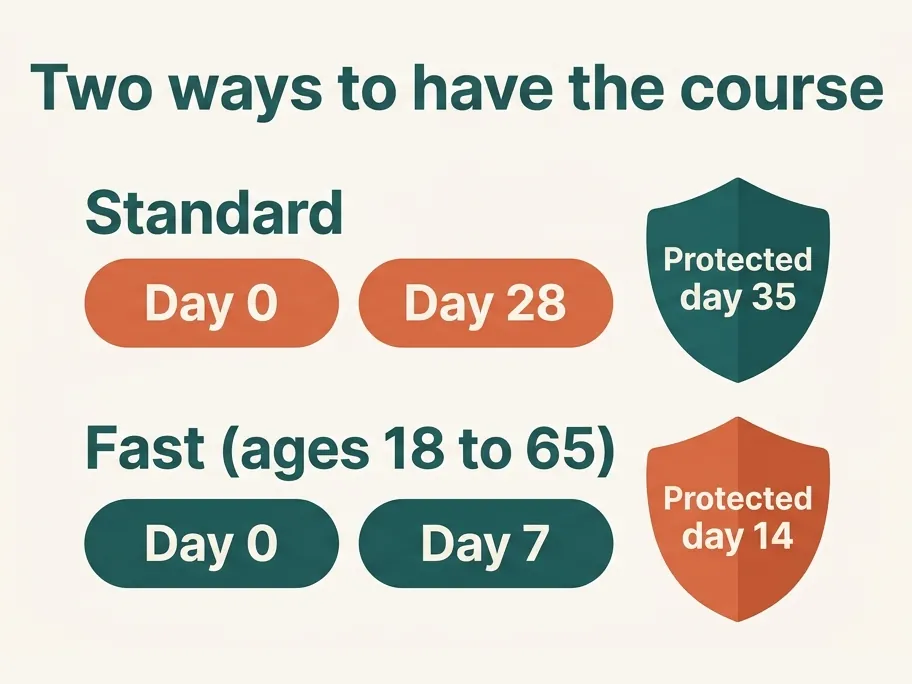
- Standard
- Two doses 28 days apart, for everyone from two months old. Children under three have a half dose. Allow about five weeks before you'd be exposed.
- Accelerated
- Two doses seven days apart, licensed for adults aged 18 to 65. Allow two weeks before exposure. For children and adults over 65 short of time, the pharmacist can consider it outside the licence.
- When protection starts
- Seven days after the second dose. One dose on its own isn't enough, and the course should finish at least a week before you might be exposed.
- Finish it here
- The vaccine is only available in a small number of Asian countries, and the course should be completed with the same vaccine. Plan to have both doses before you fly.
What it costs
Price
| Vaccine | What that covers | Price |
|---|---|---|
| Japanese encephalitis | 2 doses, £100 each | £200 |
One price, paid when you book.
Work it out
When do I need to start?
Enter your travel date and age, and this shows the latest start date for each schedule.
This works out an answer in your browser. With JavaScript off, the sections below say the same thing in full.
Call us on 020 8393 1000Your answer
- I know when I'm flying
- Latest start for the standard schedule and, for ages 18 to 65, the accelerated one, with the date protection begins
- My course was interrupted
- What's left and when, without restarting
- I know which schedule
- Both dose dates and the date protection is expected
Dates show timing only. Suitability and stock are confirmed at your consultation.
Boosters
-
Living in a risk area
A first booster 12 months after the course.
-
Going back later
A first booster 12 to 24 months after the course, before you're next exposed.
-
Adults under 65 still at risk
A second booster at 10 years.
-
Over 65
A booster at 12 months should be considered for continued risk, as the response can be lower and protection may fade sooner.
-
Interrupted
If a course or first booster was interrupted, carry on from where you stopped. Nobody needs to start again.
Avoiding bites from dusk to dawn
The mosquitoes that carry Japanese encephalitis bite in the evening and overnight, the opposite of the daytime-biting mosquitoes that spread dengue and chikungunya. On most trips to Asia you need both habits. The mosquitoes that carry malaria bite from dusk to dawn too, so where your trip needs malaria tablets, the same habits work alongside them.
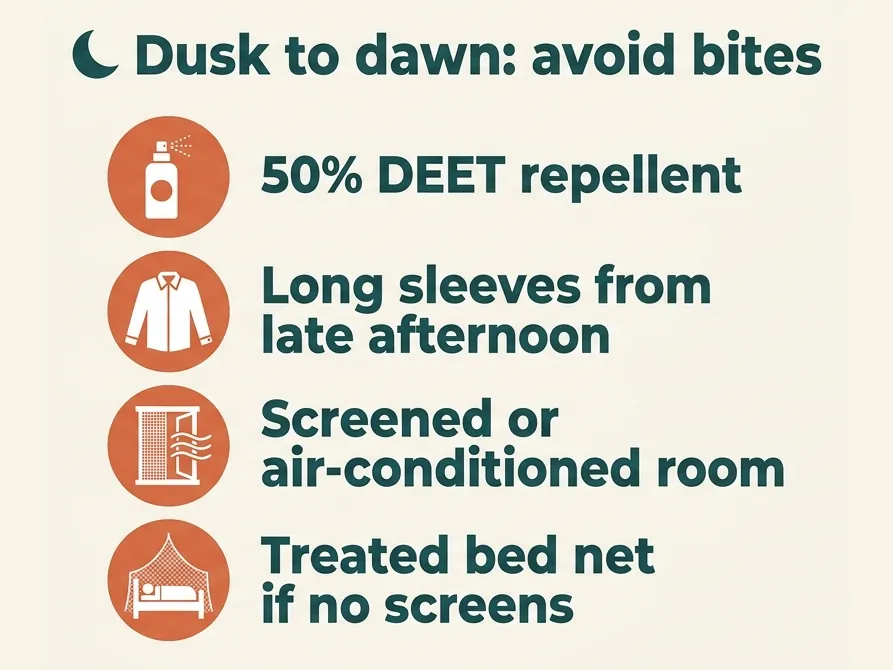
- Repellent
- 50% DEET is the most effective and suits pregnancy, breastfeeding and children from two months. Put it on after sunscreen and reapply after swimming or sweating.
- Evenings
- Long sleeves and trousers from late afternoon, especially near rice fields, farms and standing water.
- Overnight
- Air-conditioned or screened rooms, or a treated bed net where there's no screening.
- Rural stays
- Homestays and camping put you closest to the mosquitoes. That's where bite avoidance does the most work.
Safety
Safety and side effects
-
It isn't live
It's an inactivated vaccine, so it can't cause the infection.
-
Common side effects
A sore arm is the most common, in about a third of people, followed by headache, muscle aches and tiredness. These usually pass within a day or two.
-
Who can't have it
Anyone who's had a severe allergic reaction to a previous dose or to an ingredient, including protamine sulphate.
-
Pregnancy
It's generally avoided in pregnancy and only given if the risk of infection clearly outweighs the risk of vaccination. It's considered fine while breastfeeding.
-
Bleeding disorders and weakened immunity
People with bleeding disorders may need the injection given differently, and people with weakened immunity may respond less well. We'll go through both at the consultation.
Your appointment
What the consultation involves
- Bring
- Your itinerary, including any rural stops, your travel dates, any vaccination records and a list of your medicines.
- The assessment
- We go through where and when you're travelling and what you'll be doing, and tell you honestly whether the vaccine is worth it for this trip.
- Booking both doses
- If you go ahead, we book your second dose before you leave so the course finishes in time.
Before you book
Questions about the japanese encephalitis vaccine
Answered by the pharmacist who signs this page off.
-
£100 per dose, £200 for the two-dose course.
-
There's been a national shortage since summer 2026, but Miles Pharmacy has the vaccine in stock now (checked 6 October 2026). Book online and we'll plan both doses around your dates.
-
It depends on your trip rather than the country. Short city and beach trips are usually low risk. A month or more, rural areas, trekking or time outdoors after dark in the transmission season are when it's worth considering.
-
About five weeks on the standard schedule, or two weeks on the accelerated schedule for adults aged 18 to 65. The course has to finish at least a week before you might be exposed.
-
No. You need both doses, and protection starts a week after the second.
-
It's best not to plan on it. The vaccine is only available in a few Asian countries, and the course should be completed with the same vaccine.
-
It's licensed for ages 18 to 65. When time is short, the pharmacist can consider it outside the licence for younger children and older adults. The standard schedule works for everyone from two months.
-
If you'll be at risk again, a first booster is recommended 12 to 24 months after the course, or at 12 months if you live in a risk area. Adults under 65 still at risk have a second booster at 10 years.
-
No. Carry on from where you stopped. You're protected a week after the second dose.
-
No. It only protects against Japanese encephalitis. Dengue is spread by daytime-biting mosquitoes and malaria has its own prevention, so bite avoidance covers much more than any one vaccine.
-
Rare. The overall risk for travellers to Asia is estimated at under one case per million. It's the seriousness of the illness, not how often it happens, that makes vaccination worth considering for higher-risk trips.

Guides and advice
Guides on japanese encephalitis
-
 Japanese encephalitis
Japanese Encephalitis: When to Get Your Teen Vaccinated and How Often?
-
 Ears & hearing
Microsuction
-
 Vaccinations
The flu jab
Guides are a starting point, not a diagnosis. What is right for you depends on your health history, your medicines and what a pharmacist finds on the day.
Find the pharmacy
Where to come, and when
Miles Pharmacy is in Epsom, Surrey. Patients come to us from across Surrey, including Ewell, Ashtead, Leatherhead and Banstead, and from Sutton, Cheam, Surbiton and Kingston in south-west London.

Ewell, Epsom, Surrey KT19 9UR
How to get here Parking, trains, buses and step-free access
-
The door is on Chessington Road, with step-free access
-
The station car park, on Station Approach off Chessington Road
- Address Elizabeth Court, Station Approach, KT17 1DR
-
Step-free to all platforms, by a footbridge with lifts
- Step-free to every platform (National Rail step-free category A)
- Lifts two, on the footbridge
Checked against nationalrail.co.uk
-
Outside the pharmacy, with a stop on each side of Chessington Road
-
Cycle parking at the station
Take this with you
Point your phone's camera at the code and this page opens there, with the directions one tap away.
Sources
- NaTHNaC: Japanese encephalitis. Checked .
- NaTHNaC: Japanese encephalitis vaccine out of stock, advice for travellers and health professionals, dated . Checked .
- UKHSA Green Book chapter 20: Japanese encephalitis. Checked .
- CDC: areas at risk for Japanese encephalitis. Checked .
- Canadian Immunization Guide: Japanese encephalitis vaccine. Checked .
Travel health
Book before you pack.
Choose a service and a date that suits you. One of us confirms it with you directly.
- Private and NHS
- GPhC premises 9011598
- Open until 6:30pm
Prefer to talk? 020 8393 1000