The rabies vaccine gives good protection, but it doesn’t replace treatment after a bite, scratch or lick. UK guidance says you should still get medical help without delay, even if you’ve been vaccinated. What the vaccine changes is the treatment: after a full course you’d usually need just two more doses of vaccine and no immunoglobulin, the antibody injection that’s hard to find in many countries. You can book your rabies vaccine in Epsom with us before you travel.
Why vaccinated people still need treatment
UK guidance doesn’t treat the vaccine as a substitute for treatment after an exposure. After the 2025 rabies death of a UK traveller, UKHSA said: “Local medical advice should be sought without delay, even in those who have been previously vaccinated.” NaTHNaC, the UK’s travel health service, says the same: “Prompt post-exposure treatment is needed, even if you have already had a full pre-exposure vaccine course.”
The stakes explain why. Once symptoms appear, the NHS says rabies is almost always fatal. So nobody takes a chance, whatever your vaccine history.
What the vaccine changes
NaTHNaC puts it simply: “A full course of pre-exposure vaccines simplifies and shortens the course of post-exposure treatment and removes the need for rabies immunoglobulin which is in short supply world-wide.”
| After a higher-risk bite | With a full course before travel | Never vaccinated |
|---|---|---|
| Doses of vaccine | 2: day 0 and day 3 to 7 | 4: days 0, 3, 7 and 21 |
| Immunoglobulin | Not needed | Needed for red-risk exposures |
| Time until the course is finished | Up to a week | Three weeks |
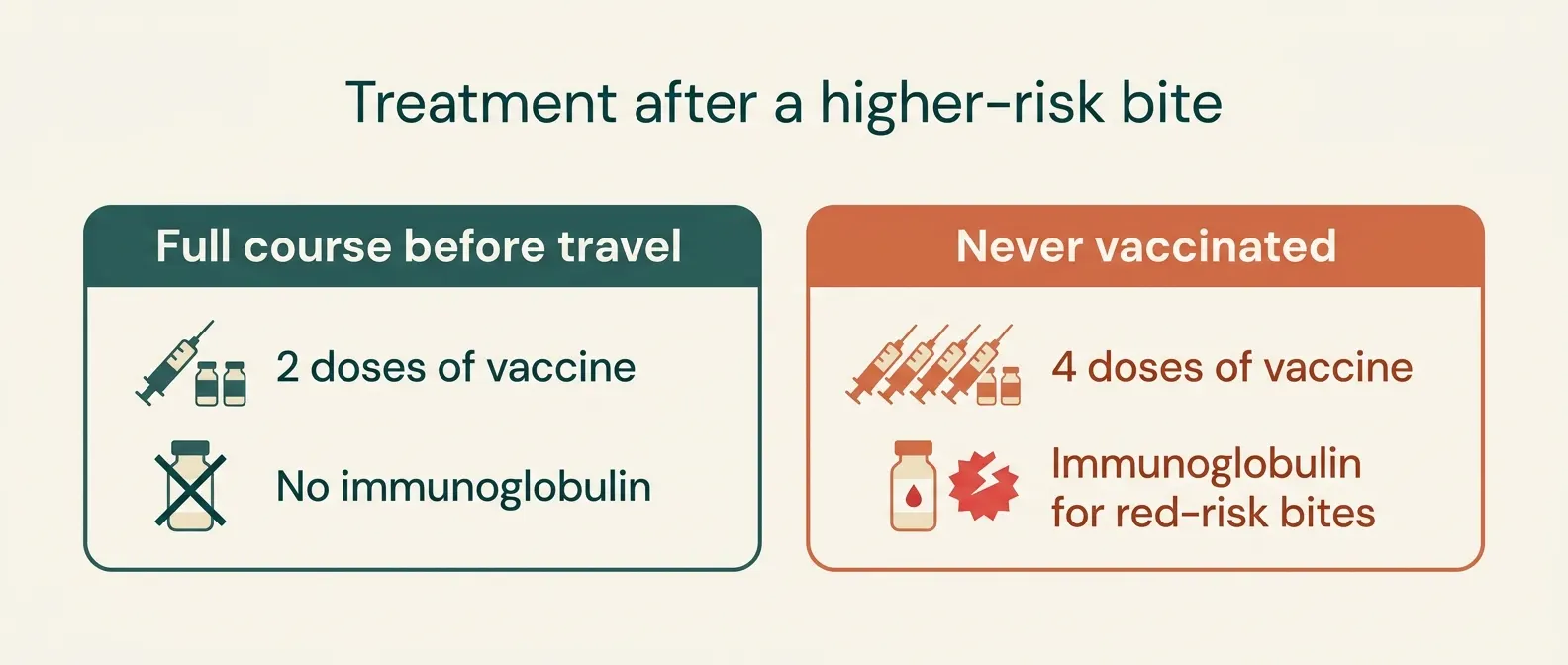
UKHSA says this holds “even years beforehand”: if you had a full course before an earlier trip, you’d still only need two doses after an exposure, and no immunoglobulin.
Why immunoglobulin matters abroad
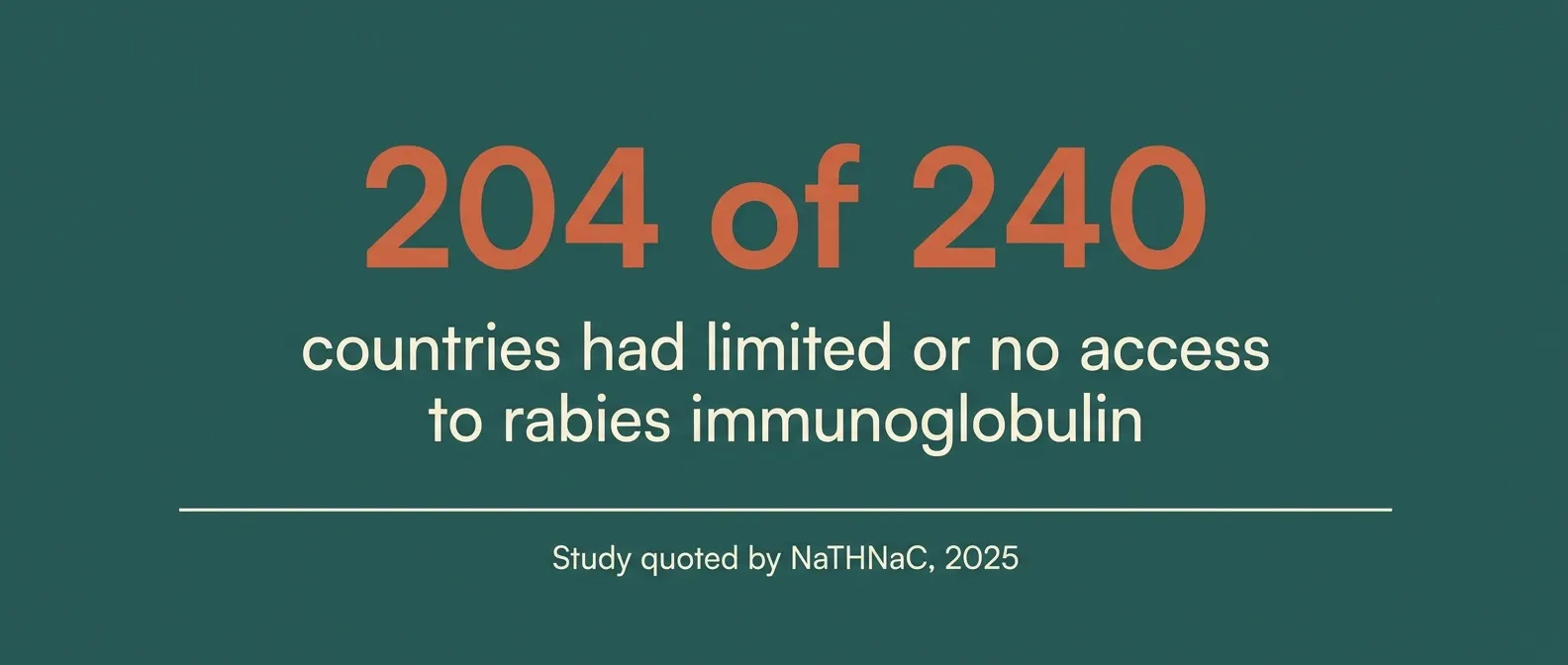
Immunoglobulin is given into and around the wound after higher-risk exposures in people who weren’t vaccinated. It’s the part of treatment that can be hardest to find. NaTHNaC quotes a study that found 204 of 240 countries had limited or no access to rabies immunoglobulin. Without a full course, a higher-risk bite on holiday means you need it, wherever you happen to be. With one, the vaccine alone is usually enough.
What counts as fully vaccinated
UKHSA counts you as fully immunised after at least three documented doses of rabies vaccine, given on at least two separate days. Fewer than three injected doses counts as partially immunised, and after a bite partially immunised people get the same four-dose course as people who’ve never been vaccinated. That includes the two-dose course recommended by the World Health Organization, which NaTHNaC says counts as partial in the UK. Our guide to how many doses of the rabies vaccine you need explains the courses.
“Documented” is the word to notice. Keep a record of your doses with your passport, so a doctor abroad can see what you’ve had.
If you have a weakened immune system
UK guidance treats people with a weakened immune system differently: after an amber or red-risk exposure they get immunoglobulin and five doses of vaccine, whether or not they were vaccinated before. If that applies to you, tell the pharmacist at your appointment.
If you’re vaccinated and get bitten
- Wash the wound under running water with soap for several minutes.
- Get medical help locally the same day, and show them your vaccine record. The NHS says not to wait until you get back to the UK.
- Contact your GP when you’re home, even if you were treated abroad.
Our guide to whether 7 days is too late for the rabies vaccine after a bite covers what happens next in more detail.
Getting your course in Epsom
We have the rabies vaccine in stock at our Epsom pharmacy (checked October 2026), at £80 a dose or £240 for the three-dose course. We’re at 94 Chessington Road, Ewell, Epsom, KT19 9UR, with Ewell West station nearby, step-free to every platform. People come to us from Epsom, Ashtead, Leatherhead and Surbiton, and we’ll book your later doses before you leave your first appointment. Call us on 020 8393 1000.
Questions about rabies after vaccination
Can you get rabies if you’ve had the vaccine?
UK guidance doesn’t treat the vaccine as a replacement for treatment, so you should get medical help after any bite, scratch or lick, even if you’ve been vaccinated. The vaccine makes that treatment shorter and simpler.
How many injections will I need after a bite if I’m vaccinated?
Two doses of vaccine, on day 0 and between days 3 and 7, if you’ve had a full course and your immune system is working normally.
Do I need immunoglobulin if I’m vaccinated?
UKHSA says immunoglobulin isn’t required for people previously immunised with rabies vaccine, unless they have a severely weakened immune system.
I had my course ten years ago. Does it still count?
UKHSA says a full course before travel, “even years beforehand”, means two doses after an exposure. Bring your records to your appointment, and the pharmacist can also talk to you about whether a booster is worth considering for your next trip.
I only had two doses. Am I covered?
In the UK, fewer than three doses counts as partially immunised, so you’d get the four-dose course after a bite. Talk to the pharmacist about finishing your course before you travel.
Sources
- UKHSA: rabies case confirmed following contact with animal abroad (18 June 2025), checked 3 October 2026
- NaTHNaC: worldwide rabies risk reminder, checked 3 October 2026
- NaTHNaC: Egypt, checked 3 October 2026
- NaTHNaC: rabies factsheet (20 June 2025), checked 3 October 2026
- NaTHNaC: rabies vaccine shortage, advice for health professionals, checked 3 October 2026
- UKHSA: rabies, summary of risk assessment and treatment, checked 3 October 2026
- UKHSA: interim recommendations for rabies immunoglobulin use (30 June 2025), checked 3 October 2026
- UKHSA: guidelines on rabies post-exposure treatment (January 2023), checked 3 October 2026
- UKHSA: Vaccine update, issue 361 (July 2025), checked 3 October 2026
- UKHSA: the Green Book, chapter 27, rabies (May 2023), checked 3 October 2026
- NHS: rabies, checked 3 October 2026